




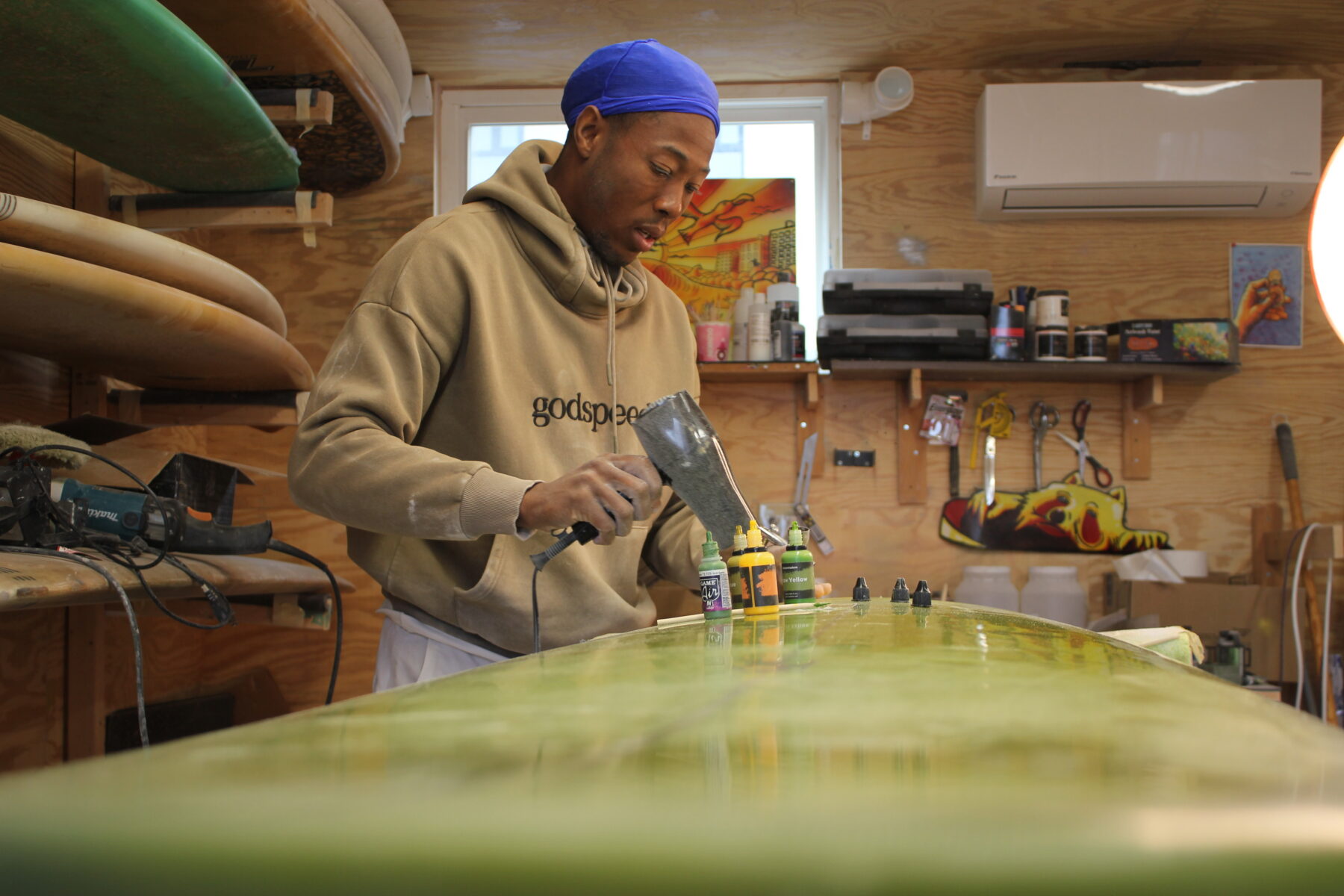
In his shipping-container workspace, Rockaway shaper Paul Godette repairs a dent in a client’s board, part of his effort to keep surfboards in use instead of tossed out. (Credit: Kate Waxman)
On the edge of a marina in the Rockaways, behind rows of fishing boats and rusting chain-link fences, sits a cluster of windowless shipping containers. From the outside, they look like storage units, but inside they are thick with foam dust and the smell of resin and solvents.
This is the center of New York City’s small surfboard manufacturing scene, where shapers carve foam into hydrodynamic boards.
Most surfers go through boards quickly, and many own five to ten at a time. The global surfboard market is projected to reach around $4 billion in 2026 and about $6 billion by 2033. For professionals, the pace is extreme. “Most average pro surfers go through 150 surfboards a year,” said Chuy Reyna, a representative of Firewire Surfboards.
That demand at the professional level ripples outward through the entire surfboard market. “There’s a high demand for marketing surfboards,” said Paul Godette, a Rockaway shaper who works out of a pale blue shipping container. “The pro-surfer feedback loop keeps pulling new designs into existence—there’s always going to be creation.”
In a culture built on buying the next shiny model, it is rare to repair instead of replace. In addition, most of the materials shapers rely on to make surfboards are derived from plastics and short-lived: fiberglass, polyester foams, and polyester resins. But the global surfing community is increasingly grappling with the paradox of contaminating the oceans that they love and, often, advocate for. “There’s nothing worse than leaving the beach and seeing a broken board in the trash,” said Reyna. “There’s no real recycling for it — it just goes to a dump.”
In New York City, shapers are trying to respond in three ways: by keeping old boards alive, experimenting with eco-materials like agave and flax whenever the East Coast supply chain allows it, and building high quality ones that won’t fall apart as quickly.
Godette, who was born and raised in the Rockaways and has been surfing his entire life, is focused on reuse.
“I keep boards in their current lifespan,” said Godette. “I’m giving people an option to keep boards for years on end instead of buying new ones.”
Godette has repaired more than 100 boards for the surf communities of New York and California; he also frequently repairs dents in his own boards. “I’ve repaired all of my boards. Ironically, I haven’t had many boards,” Godette said. “I’ve had less than 20 boards total…and I’ve repaired all 20 of those.”
Ryan Harris, a California-based eco-shaper, agrees with Godette’s approach. He believes that stripping down old boards to their foam cores brings a new life to them, because the fiberglass shell often fails long before the foam inside loses its structural integrity.
“These old boards are charged with kinetic energy, it’s way better than a virgin blank,” Harris said. “It becomes a magic board for the next surfer.”
Surfboards weren’t always made of toxic materials. The first boards, made in the early 1800s in Hawai‘i, were carved from woods like koa and breadfruit. They weighed 70 pounds or more. Raw tree trunks were shaped with axes, smoothed with coral, finished with tree bark. They were heavy but organic—returning to the earth at the end of their lives.
Everything changed in 1956, when polyurethane foam entered surfboard manufacturing. Suddenly, boards were lighter, faster, and easier to mass-produce. Polyurethane foam cores, wrapped in fiberglass cloth and sealed with polyester resin, became the dominant surfboard design.
Expanded polystyrene foam followed in 1950, which, when paired with epoxy resins, led to lighter boards that were marketed as eco-viable alternatives. These surfboards emitted about 30% less carbon over their lifetime than standard polyurethane foam boards, according to a ECOBOARD lifecycle analysis.
The ECOBOARD Project, founded in 2012, is a certification program run by the non-profit Sustainable Surf that evaluates and labels surfboards made with what they consider lower-impact materials: an effort to reduce the sport’s carbon footprint and shift manufacturers toward more sustainable construction.
Under the ECOBOARD label, lower-impact boards typically use recycled expanded polystyrene foam, bio-based epoxy resins partially derived from plant materials, and fiberglass cloth with recycled content. Sustainable Surf’s lifecycle analyses estimate these constructions can cut carbon emissions by roughly 20 to 30% compared to conventional polyurethane boards.
Most ECOBOARD-certified suppliers are based in California and Australia—meaning access to these materials depends heavily on proximity to those supply chains, creating a geographic divide between shaping hubs on the West Coast and smaller, more isolated shaping communities like those on the East Coast.
There is some debate among shapers about the quality of several of the certified bio-based and epoxy resins.
Godette thinks that using bio-epoxy resin for repairs doesn’t change the quality of the board or the ease of use. “It sands really smooth, some people use it to glass entire boards,” he said.
Other shapers disagree. Christopher Campbell, who shapes in a studio loft in SoHo, prefers to use polyester resin: “it cuts like butter.” He said that the shaper must ask themself if they are going to make fewer mistakes, as he does when using polyester resin, which means the boards will better withstand wear and tear—and be less likely to be quickly discarded.
Jimmy O’Brien, another Rockaway shipping-container based shaper, agrees that some eco-boards aren’t built to last. Expanded polystyrene foam “is basically styrofoam. Once it breaks down, it just breaks down into smaller beads that last thousands of years,” he said. “I haven’t met a single person with an epoxy board that has recycled it.”
Even so, Campbell would like to experiment more and try making boards with other sustainable materials like flax or agave, which are used to reduce petroleum content and improve durability, though they can slightly increase weight and are not widely available outside major surf manufacturing hubs. “It’s simple economics,” Campbell said. “Ten times more people surf on the West Coast, so there’s ten times more materials made. We’re stuck on the scraps.”
These shapers all agree that one of the most successful methods to maintain sustainability in shaping is to produce higher quality boards that can be passed down through generations. “You can get a board for a third of the price, and they’re all still good,” Campbell said. “The biggest impact you can make is in the second-hand board market.”
This is the same strategy now used by Paul Schmidt, a longtime Rockaway surfer and native New Yorker who has been shaping for 20 years. Unlike most modern boardmakers, Schmidt still shapes, paints, glasses, and sands his own boards. “I used to build boards at a faster pace with lower-quality materials just to keep up,” he said. But those boards dented after one season.
Over the years, he has moved towards producing high quality heirloom boards. “I don’t think we need more boards,” he said. “The more beautiful it is, the more likely it is to stick around.”
Recently, Godette rebuilt a fin box—the housing built in the bottom of a surfboard that holds the fins—on one of his own boards. It had been “completely twisted out of the fiberglass and foam.” It took two days to reset and glass. “It feels amazing!” he said of his redesign, which adjusted the fins for more control in steep waves.
Godette has reshaped his own repaired boards and paddled back out, testing the new lines himself. In a sport obsessed with the next new board, he keeps returning to the old ones — fixing them, riding them, proving they still have life.
About the author(s)

Kate Waxman is an environmental journalist reporting on oceans, climate science, and the communities shaped by changing ecosystems.