




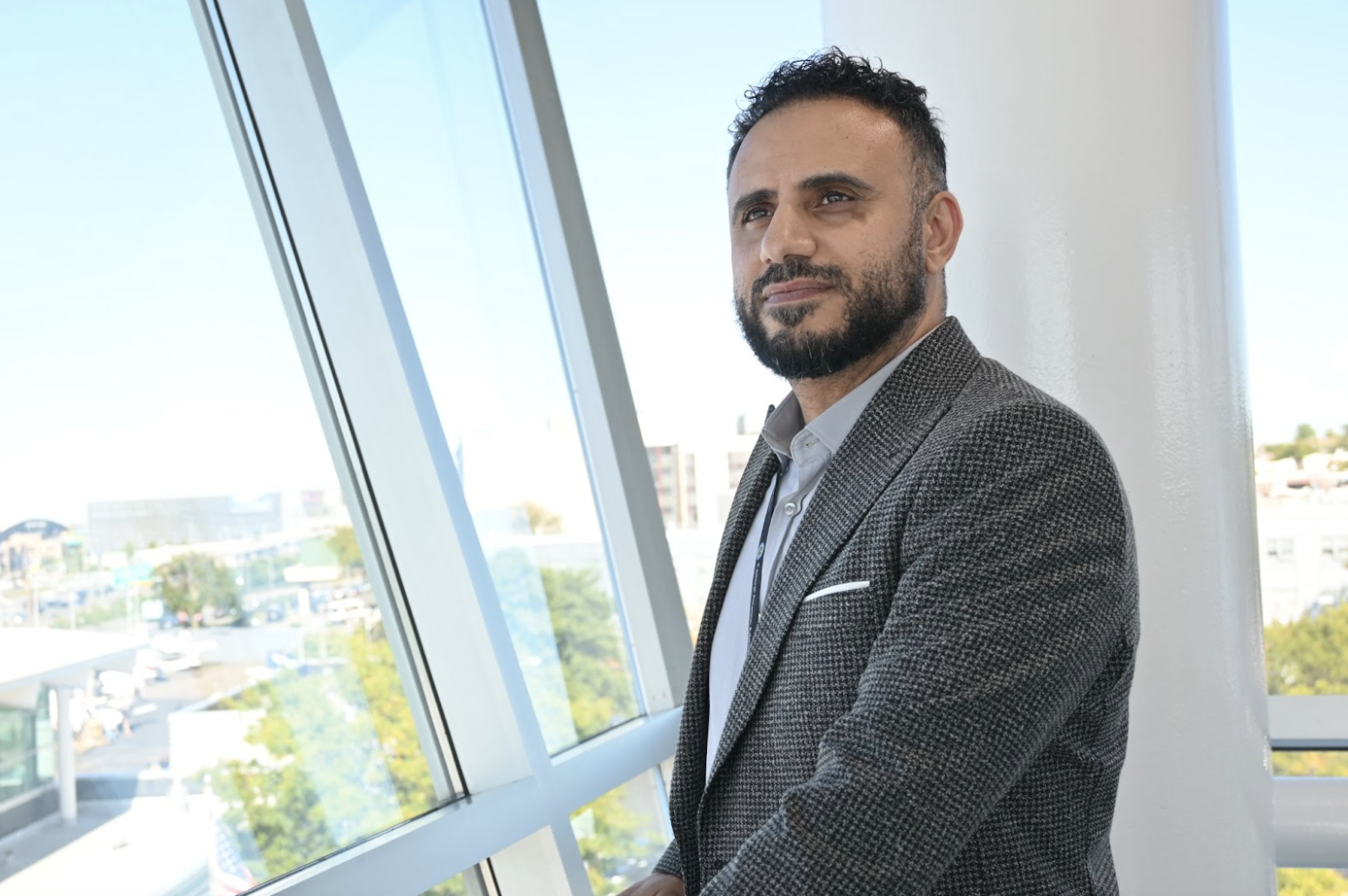
Yahay Obeid, an air traffic controller, is weathering his second government shutdown. (Credit: Hope Zhu)
Two days after the government shutdown, Yahay Obeid stood outside Sheel Mashi, a Kuwaiti-Lebanese fast-food restaurant, celebrating its first U.S. opening in Bay Ridge, Brooklyn. Arab pop thundered down Fifth Avenue, and what began as ribbon-cutting turned into a full-blown block party. When the countdown hit zero, people surged: shoulder to shoulder, phones flashing, packed so tightly that the restaurant’s door barely budged.
From the curb, Obeid, president of the Alliance for Yemeni American Businesses, saw the workers freeze. He waded in, suit pressed, motioning people back and guiding a few inside. When the rush finally settled and customers lined up for free sandwiches, he stepped aside, watching.
Earlier, he told the crowd that he was there to steer Yemeni American entrepreneurs toward the city’s small business resources. The next day, he headed off to direct another kind of traffic—up in the control tower at John F. Kennedy International Airport.
The last week in October, Obeid and his team at the tower opened their paystubs to see zeros for the first time since the shutdown. Some colleagues also missed shifts to care for newborns or take sick leave, but most air traffic controllers remained on duty as essential workers.
Obeid faults both parties for the gridlock that’s kept them working without pay. “There’s not one person that needs to take 100% of the blame,” he said.
But he is cautious about raising alarms. A 2019 law guarantees back pay for federal workers like air traffic controllers once Congress funds the government, but the Senate failed for the 12th time to advance a House-passed bill to end the shutdown last Wednesday.
During the ongoing government shutdown, 14,000 air traffic controllers like Obeid across the country continue to direct flights without pay. Officials have threatened to fire anyone who skips their shifts. Across the nation, short staffing has already caused delays at major airports, including New Jersey, Orlando, California, Nashville and Tennessee. Nick Daniels, president of the National Air Traffic Controllers Association, told NPR that air traffic controllers are working “under one of the lowest-morale times in history.”
But Obeid, 42, knows how to guide both planes and people. For 14 years, he has directed flights over Kennedy Airport’s busy runways and Yemeni small business owners through New York’s regulatory maze. In the Bronx’s Morris Park neighborhood, he is a voice for its growing Muslim community and the first nonwhite member of Community Board 11. He is soft-spoken yet outspoken; when the traditionally liberal Morris Park neighborhood shifted toward Trump by 10% in 2024, Obeid talked openly to the media about his votes for both Trump and Alexandria Ocasio-Cortez, two opposites he felt both “had a human side” and “work very, very hard for their constituents.”
And he is no stranger to rough air. After 9/11, suspicion trailed Arab American airline professionals like him. Then came the pandemic, and before that, a 35-day government shutdown in late 2018 that grounded paychecks across the country. This was when Obeid reached out to his congresswoman, Alexandria Ocasio-Cortez, who, in January 2019, told his story in her first House floor speech.
“Every single day, an air traffic controller has thousands of people’s lives in their hands,” Ocasio-Cortez said. “And it’s terrifying to think that almost every one of them is distracted at work because they don’t know when their next paycheck is coming.”
That moment cemented Obeid’s support for Ocasio-Cortez. He felt she listened to voters like him, especially about the job’s pressure.
“It’s a challenging career,” he said. “It’s not made for everybody.”
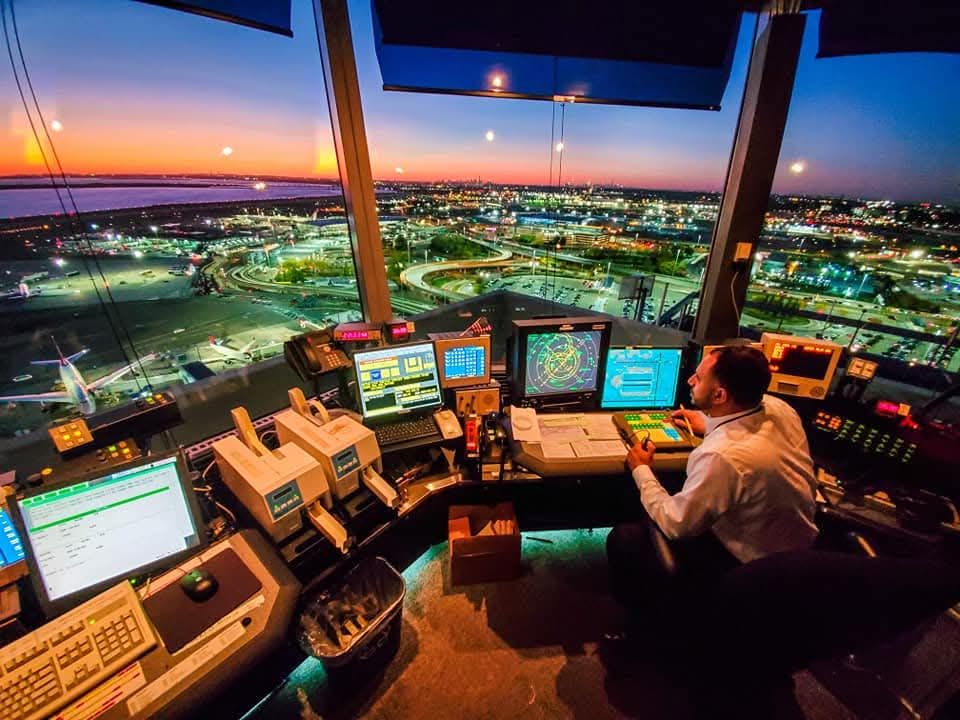
Obeid in JFK’s air traffic control tower. (Courtesy: Yahay Obeid)
If the job isn’t for everyone, it seems made for Obeid. His connection to the sky started at age 8, when he first landed at the same airport where he’d later spend decades working. His father, already in the U.S., brought him a long way from the village in Ibb, Yemen, where he grew up among ripening coffee beans and sandbags stacked against stray bullets from village infighting.
Obeid spent most of his 1990s childhood in Yonkers, then moved to Harlem in the 2000s when his father opened a deli at 340 Lenox Avenue. Starting around 14, Obeid was behind the counter, stocking, bagging, and covering shifts. All the while, his eyes were on the sky.
“There is the phrase, ‘the sky is the limit’,” he said. “I wanted to do something that no one in the family has done.”
Between shifts and classes at Vaughn College, a specialized aeronautical school in Queens, Obeid studied wherever he could: on the train, between classes, atop of Vaughn’s control tower, where he could see LaGuardia’s runways stretching below. His plan is to become a pilot. Air traffic control was a backup.
He graduated with degrees in airline management and air traffic control in 2005, and completed his pilot training in 2008—a bad year to chase the skies, especially for Muslims. The financial crisis and rising fuel prices grounded fleets and cut jobs to historic lows. And after 9/11,target surveillance programs and employment discrimination framed as counterterrorism measures shut out many Muslim and Arab Americans from high-security fields like aviation. In Missouri, a Muslim pilot lost his job over his faith and appearance, according to a 2003 lawsuit.
Obeid had his share of headwinds. Agents from the Federal Bureau of Investigations would stop by the grocery store where he worked, he said, asking about his income as part of the background check.
“I faced a lot of challenges… a lot of investigations by the FBI for no reason,” Obeid said. “But you know, they had to do their job.”
During his pilot exam on the second anniversary of 9/11, he recalled the examiner took one look at him after the plane took off and declared, “You failed.”
When he asked why, no answer came.
“I knew it was racism,” Obeid said.
None of that stopped him. Obeid retook the exam the next year—with the same examiner—and passed.
“I wasn’t willing to give up the fight,” he said. After a few years working for the Transportation Security Administration in Orlando and completing a two-year air traffic training program at Kennedy Airport, Obeid earned his spot in Kennedy Airport’s control tower on an eight-person team, guiding roughly 1,200 flights a day through New York’s busiest skies.
Obeid also taught air traffic control and aviation weather at Vaughn for five years; students remembered the sort of instructor who pushed them without condescension.
“He’s kind and he is blunt,” said Habib Ahary, his former student and now a pilot. “He’ll tell you what you need to fix. He’s going to get you prepared when you get to the airport.”
Ahary later co-founded the nonprofit Arab American Aviation Professionals with Obeid to guide young students into aviation. He said Obeid was a model of what was possible when post-9/11 suspicion had crushed that dream for many Arab Americans.
“If he can do it, we can do it,” he recalled thinking.
As the shutdown stretched on and controllers called out across the country, Obeid assessed every patch of turbulence, both in the skies and in the halls of power. Weeks earlier, he’d sat down with Ocasio-Cortez, trading notes on no-interest loans and food aid for federal workers. Since she last talked about his struggle, he has more savings now, but also a heavier mortgage and a deeper sense of responsibility: There was no question he would be in the tower, paid or not.
“We hold a position of public trust,” he said. “And we have to do the right thing, even when the elected officials don’t.”
About the author(s)

Hope Zhu is an M.S. student at Columbia Journalism School and has previously covered topics including immigration, retail, and travel.