




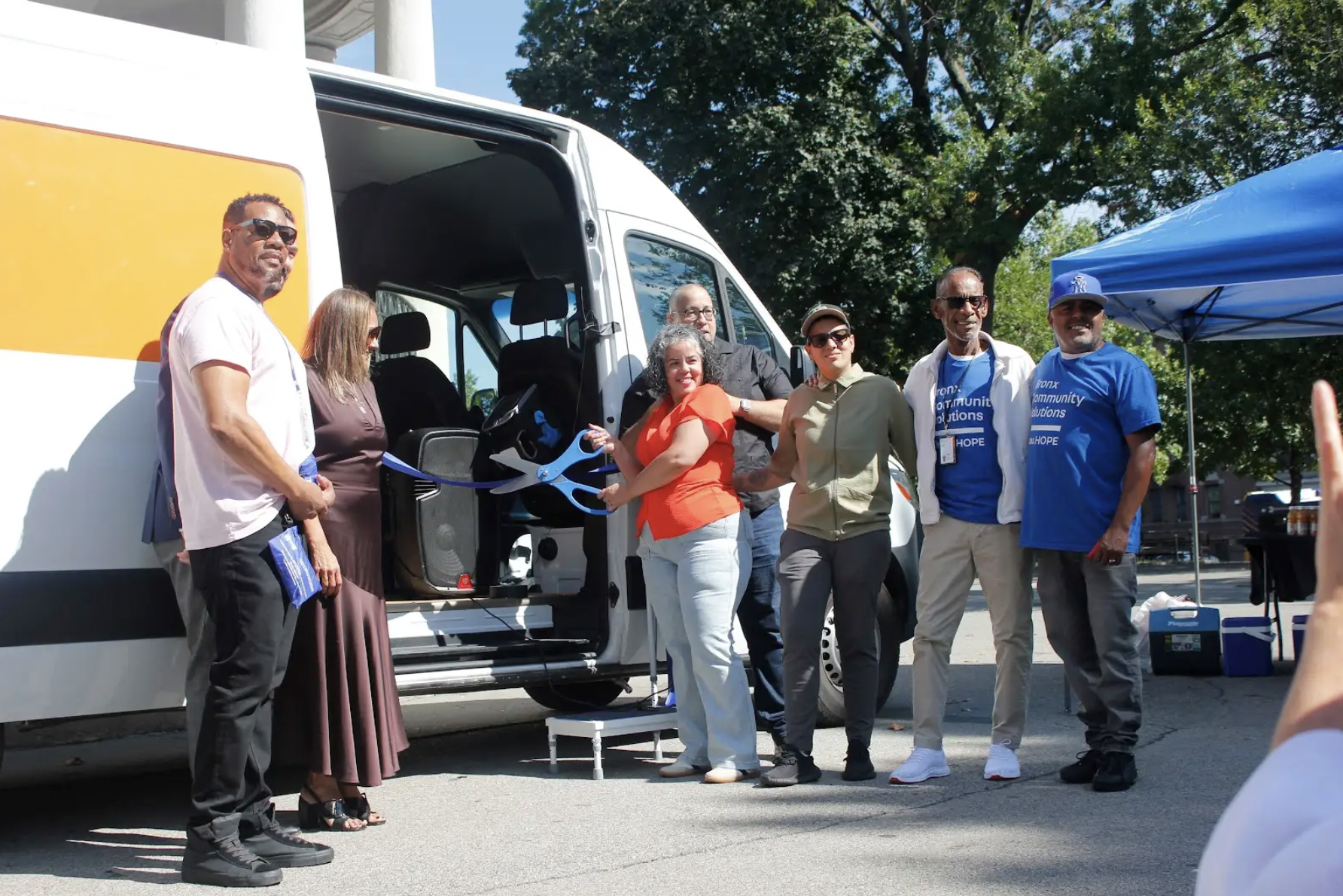
Staff and supporters of Bronx Community Solutions gathered in Poe Park for the launch of the HOPE-Mobile Outreach van. (Credit: Anna Lee)
Bronx residents now have one more option when it comes to harm reduction.
On Sept. 26, Bronx Community Solutions, a Center for Justice Innovation project that provides people with community-based support and alternatives to jail, held a ribbon-cutting ceremony to mark the launch of its HOPE-Mobile Outreach van. The new vehicle is designed to support individuals with substance-use issues or criminal charges, and it was unexpectedly put to use for the first time. The new van is part of BCS’s Bronx Heroin Overdose Prevention and Education (HOPE) initiative, through which peers assist people struggling with substance use across the Bronx’s 12 precincts. The ceremony in Poe Park on the Grand Concourse in the Bronx had just concluded when HOPE peer specialists, who connect people with treatment providers and substance intervention services, spotted a non-responsive man who had overdosed in the park.
The peer specialists then administered Narcan, the brand name for naloxone, a medication that can rapidly reverse the effects of an opioid overdose, one of the supplies stored in the HOPE-Mobile. They then called emergency services after the man regained consciousness, though he declined further medical assistance after an ambulance arrived.
The event, led by Magaly Melendez, a senior program coordinator for BCS, was attended by affiliates from the Center for Justice Innovation, Youth Impact Bronx, and other organizations concerned with social reform. New York State Senator Gustavo Rivera, who secured $100,000 for the HOPE-Mobile’s purchase through capital funding, also attended.
“I am an enormous supporter of harm reduction and the idea that people who use drugs should be treated with respect and dignity,” Rivera said in an interview. “This is an extension of that.”
The HOPE-Mobile is outfitted with food, seats, medical equipment, and to-go “crisis bags” which include Narcan, fentanyl strips, oral hygiene materials, snacks, and water. Once someone has been charged with drug possession and determined eligible for HOPE’s services by the Bronx District Attorney, a peer and a case manager will meet a client where they are located and welcome them into the HOPE-Mobile. The HOPE-Mobile will also provide community outreach services to individuals with substance-use issues in need of immediate assistance, like the naloxone administration. The van will also transport people to homeless shelters, treatment centers, and next-level services.
The HOPE-Mobile is modeled after a harm-reduction approach, which aims to minimize the legal, health, and safety implications of drug use. One of the key principles of the HOPE program is that participants receive help voluntarily — an approach that has been criticized by many, including New York City Mayor Eric Adams. In August, despite little evidence proving the effectiveness of compulsory drug treatment, Adams proposed the “Compassionate Interventions Act,” which would authorize the involuntary commitment of people with substance use disorders.
Instead of compulsory treatment, the HOPE-Mobile is intended to connect at-risk individuals with support through peer facilitation. According to Michelle Rodriguez, a supervisor and certified recovery peer advocate, peer specialists — the job title shared by those who successfully administered Narcan to the man in Poe Park — hold a special role in the HOPE-Mobile.
“We try to hire our peers with lived experience, so they know how to deal with the clients; how to approach the clients,” Rodriguez said.
Most of HOPE’s peer specialists have personal experiences with drug addiction or substance-use issues. Segundo Lopez, a peer specialist, has been in recovery for over 30 years.
“It’s an opportunity, through pain and suffering, to turn it around, and start over,” he said. “We’re the face of people who were ridiculed, judged, incarcerated, homeless, evicted.”
Diana Perez, another HOPE peer specialist, dealt with her own substance-use issues and involvement with the criminal justice system. She recalled feeling more comfortable speaking to people who had also experienced addiction.
“I wasn’t afraid of talking to people who understood where I was coming from,” she said.
In addition to launching the HOPE-Mobile Outreach van, the event in Poe Park was intended to honor Anthony Kohl, who died in a traffic accident in early September. Kohl was one of the first peer specialists at Bronx Community Solutions and had won the National Council for Mental Wellbeing Peer Specialist of the Year Award in May. Rodriguez, Lopez, and Perez and State Sen. Rivera congregated with other HOPE peer specialists in a moment of silence during the tribute.
To Rodriguez, the van represents Kohl’s vision for Bronx Community Solutions and the services that he wanted to provide to people struggling with substance-use. In Kohl’s memory, she hopes the organization will continue to expand its peer specialist network and HOPE-Mobile program.
“We’re doing our work because he didn’t want us to stop,” Rodriguez said. “That’s why we keep on.”
About the author(s)

Anna Lee is a general assignments reporter based in New York and Boston. They are currently reporting on environmental legislation and criminal justice reform.