




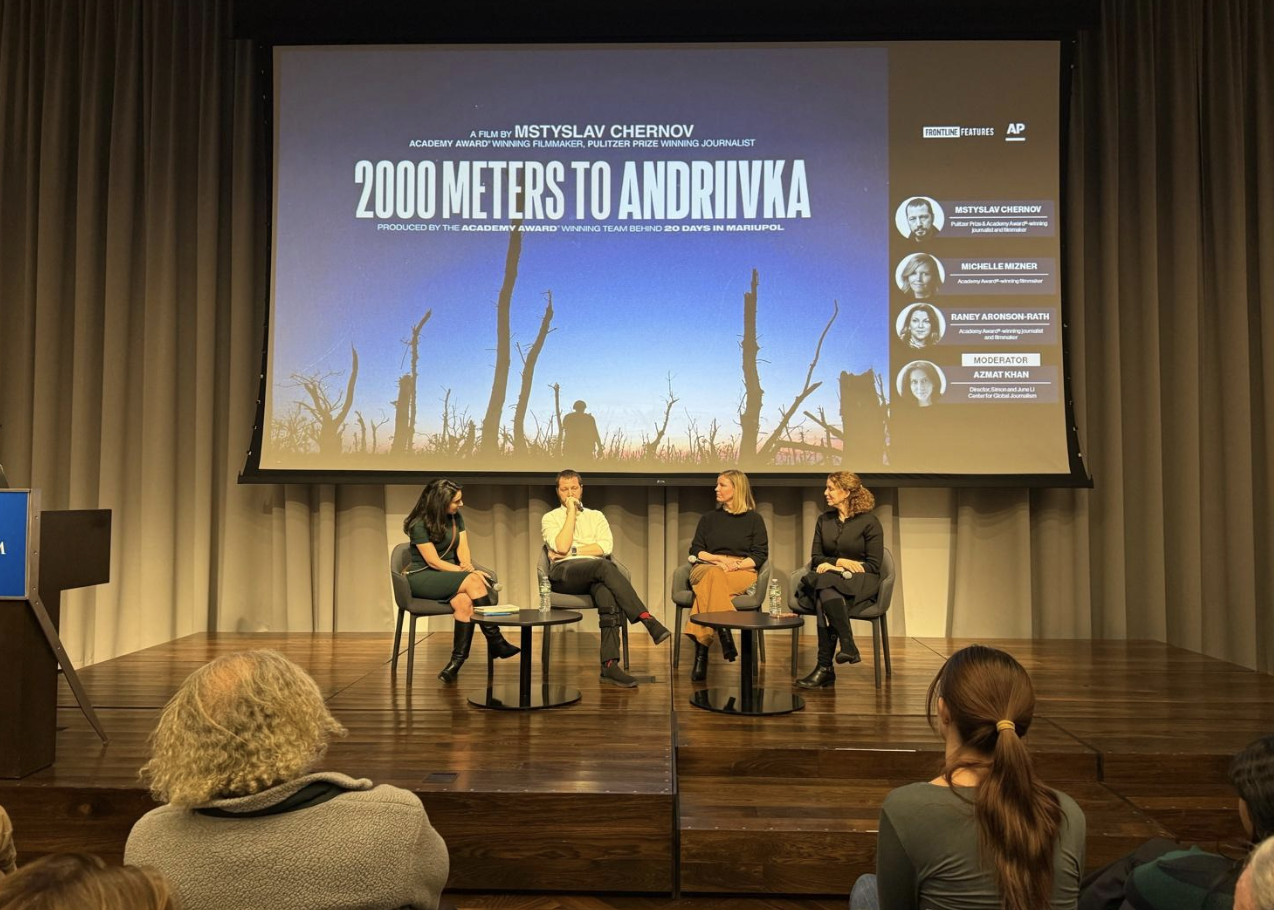
Mstyslav Chernov speaks at Columbia Journalism School after a screening of his film (Credit: Tom Mutch)
“Even far away from war, war is always with you,” Mstyslav Chernov said.
The Oscar and Pulitzer Prize winning Ukrainian director of 20 Days in Mariupol and 2000 Meters to Andriivka sat in the World Room at Columbia Journalism School, thousands of miles from the frontlines of Russia’s invasion. But the war never leaves his thoughts.
“I am part of this Ukrainian community,” Chernov continued. “And everyone has lost someone. Every family has someone who is fighting on the frontline.”
I met him in November during a screening of his latest documentary 2000 Meters to Andriivka. With his long-time collaborator Evgeny Maloletka, Chernov captured some of the defining images of the full-scale invasion. Their work on 20 Days in Mariupol, a harrowing account of the siege of the southern port city, won nearly every major award in journalism and filmmaking.
But with the follow-up, 2000 Meters to Andriivka, Chernov chose to turn his camera in a different direction, away from civilians and toward soldiers. It was a conscious choice to move from covering suffering to resistance. Why focus on such a little-known village? Why shift the lens to men in uniform?
“These people are not soldiers by choice,” Chernov said. “They are civilians. In between combat they are students, grandfathers, truck drivers, warehouse workers. If this invasion didn’t happen, they would be at home with their daughters, granddaughters, wives, brothers, sisters. They answered the call because their home was invaded.”
But telling the story of soldiers, he said, is far harder than civilians.

Matthew, a soldier from the Third Assault Brigade, where Chernov embedded for the film (Credit: Tom Mutch)
“It is absolutely more difficult to make a story about a soldier than about a civilian, for many reasons. One being that, of course, there is agency. In their hands, there is a weapon. They are all wearing uniforms, and uniforms make us similar.”
The danger, he explained, lies in collapsing into ideology.
“There is also the problem of perspective. When you are making a story about soldiers, especially one side of a war, there is a huge danger of falling into the trap of propaganda.”
In many ways, Andriivka is a deliberate counterpoint to Mariupol.
It was also a conscious choice to move from covering suffering to resistance. “I really wanted to find a story that would tell an opposite notion to what we saw before. Mariupol was about loss. About falling victim, or surviving an unjust, criminal attack. Losing your home, your family, your children, your city. Andriivka is, in many ways, a response to that. An opposite notion. The same civilians who now put on uniforms, take a gun, and go against all odds to get back what belongs to them.”
In recent months, debate has swirled around Western portrayals of Russian soldiers in Ukraine, especially after the controversial Russians at War film. Chernov has little time for efforts to “understand both sides” while the invasion is still ongoing.
“If there is a tragic story of a serial killer, who is attacking a victim, then I just don’t think it is my priority, duty, or need to show this from the perspective of the killer. Maybe after the court case is closed, after the killer is in jail, the time comes to study their psychology to make sure it does not happen again. But when we see someone killing another person on the street, we do not ask them for their opinion. We try to stop it. Then we put them in jail. Then we ask why they did it.”
“We have to push this type of journalism from a forensic perspective. Of course the perspective of the victim is the absolute priority. We have a moral obligation to portray the reasoning behind the murder. But not while the murder is happening.”

A medical stabilization point in Donetsk Oblast that treated soldiers wounded in Andriivka
(Credit: Tom Mutch)
There is a bitter irony in the fact that the village of Andriivka, briefly liberated by the Ukrainians in 2023, was later recaptured by Russian forces. So was it all for nothing?
“It was never a pyrrhic victory because it was always a battle for a symbol,” Chernov said. “A symbol of hope.
“Andriivka itself means nothing, but the symbol of that village, the picture of a flag, are all tools in keeping the nation united and hoping,” Chernov said. ”The film ends, saying, ‘Andriivka was occupied again, and as of 2025, Russia occupies 20 percent of Ukrainian land.’ I would add ‘only’ 20 percent of that land. There is a different perspective. The world is afraid of Russia. Europe is afraid of Russia. The USA is somehow afraid of Russia. Hundreds of thousands of soldiers. Drones hovering over airports of European cities. But here comes the understaffed, underequipped Ukrainian army who says, ‘We refuse to be afraid. We do not just stay where we are, we push back.’ That is amazing. The act of showing that your enemy can bleed is more important than defeating your enemy in the moment.”
As it happens, I was embedded with the Third Assault Brigade’s medical wing on the very day much of Andriivka takes place. I saw some of the same men and medics Chernov captured on camera. One talked about anger among soldiers, and a growing divide in Ukrainian society between those fighting on the front and those watching from cafes in Kyiv or Lviv.
Chernov is honest about the resentment that sometimes simmers.
“Of course that gap exists, and of course it frustrates soldiers on the frontline. It always did. But it is an oversimplification to say that all men in Kyiv, Lviv, or Chernivtsi are indifferent to Russia’s invasion. One of the reasons I made this film the way I did was to close that gap. The reason the gap feels so big is because people in peaceful parts of Ukraine do not fully see how hard the fight is,” he said.
Chernov is also an observer, not a soldier- albeit watching from the closest possible quarters. “We see news every day. Reports, drone footage. But those are not minutes lived. They are not moments between life and death. They are not bodily experiences. With cinema, to a certain extent, we can get closer to that.”
Rather than creating simple portrayals of Ukrainian heroism, which he dismisses as “what would be made in the Soviet Union”, Chernov insists on showing the reality of the war, however painful.
“Instead of a puff piece about the Ukrainian army, or a propaganda piece, I chose to make a film that showed real sacrifice and real tragedy. For people in peaceful cities, to go to cinemas and experience that.”
And what of those still standing on the sidelines?
“Many people sign up as the frontline is getting closer. That is what we saw in Kharkiv. What we saw in Donbas. I would not say you know who is who until the fight comes to your door. [Some] really do not want to fight. But even those people can change. If you live in Dnipro, and the frontline comes closer and closer, the higher the chance you will sign up,” Chernov said.
About the author(s)

Tom Mutch is a New Zealand journalist who reported extensively from Ukraine during the war. He is a current MA Journalism/Politics student at Columbia University.