




3333 Broadway in Harlem where two cases of Legionnaires’ disease were recently identified (Credit: Brooke Witherow)
Last summer, a Legionnaires’ disease outbreak in Harlem sickened more than 100 people. Seven died. At the same time, a smaller outbreak was underway in the Bronx: four people, two each from the Parkchester North and South condominiums, tested positive for Legionnaires’ disease.
The two outbreaks originated in different ways. In Harlem, cooling towers for HVAC systems housed the bacteria that causes the disease. In the Bronx, residential water systems were the reservoir.
Legionnaires’ disease is a lung infection caused by the Legionella bacterium. It is spread through exposure to small water droplets. It is not contagious. According to the New York State Department of Health, an estimated 25,000 people develop Legionnaires’ disease in the United States each year. It is fatal for about one in ten people. Now, the city has passed further legislation to target outbreaks as a result of cooling towers.
But there have been many cases from buildings that do not have cooling towers, and experts say it is becoming increasingly clear that the bacteria thrive in some residential water systems as well.
HVAC systems have long been considered the culprit for Legionnaires’ disease outbreaks because they are the ideal structure and temperature for bacteria growth, but in recent years, residential water systems have emerged as a significant source as well. The city’s health department recently investigated two cases in a Harlem apartment complex at 3333 Broadway, focusing on the building’s water system and plumbing. By Feb. 1, the department confirmed the discovery of Legionella bacteria.
Many experts say that such cases will continue to occur because current New York City health regulations only cover HVAC systems. Advocates for preventing Legionnaires’ disease say more comprehensive regulation is needed.
“That is where we need to focus prevention,” said Janet Stout, founder of the Special Pathogens Laboratory, who has studied the bacteria that causes the disease for more than 30 years. The overwhelming majority of cases of Legionnaires’, she said, are from the water running through pipes in residential buildings.
Stout said that additional regulation is a critical next step, particularly as the state and city have had a good track record of working together following major outbreaks. “New York City and New York State are ahead of other states” because of effective public health regulations of cooling towers following the 2015 South Bronx outbreak, she said.
But Thomas Leach, director of outreach and communications for the Alliance to Prevent Legionnaires’ Disease, said that even those regulations are a “historical and out of date approach to addressing the bacteria.”
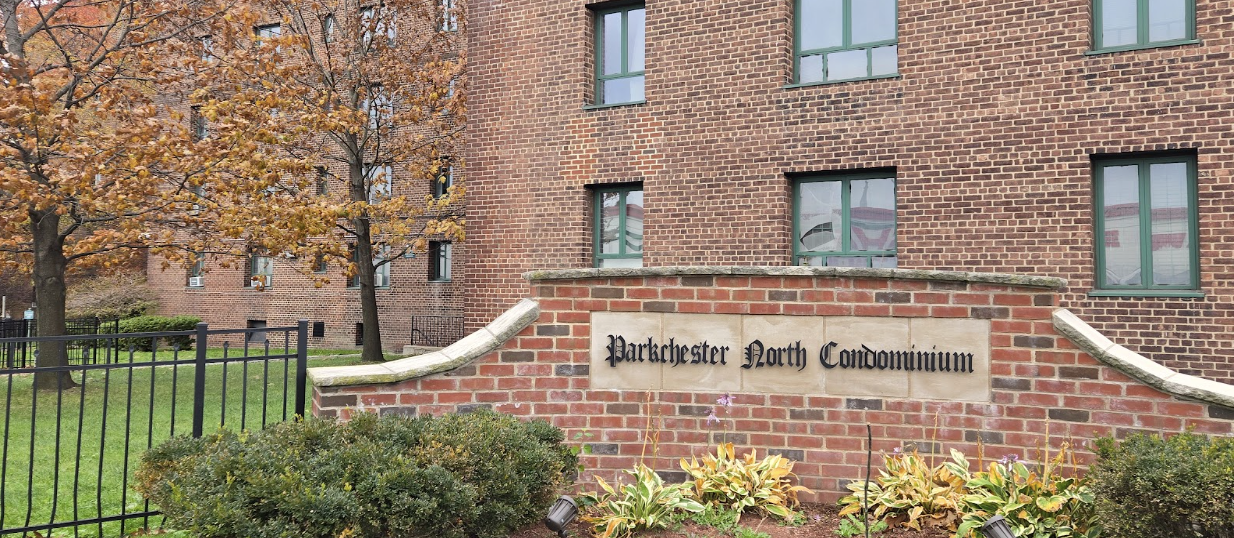
Parkchester North Condominium where two cases of Legionnaires’ disease were identified (Credit: Brooke Witherow)
New York City is considered a hot spot for Legionnaires’ disease. The city had 1,488 cases between 2019 and 2022, and 55 deaths, according to a health department surveillance report. As a result, the health department requires inspection for Legionella bacteria in buildings with cooling towers for HVAC systems, as well as cleaning and maintenance if bacteria are detected.
“We hear about the outbreaks—the Bronx, Harlem, all across the United States and the world. But we don’t hear about the majority of cases, which are sporadic,” said Stout, referring to cases that are not part of a cluster or big outbreak.
“The building water systems – the faucets, the showers – this is where Legionella lies in wait,” Stout said.
Potable water was the most frequent source of exposure to Legionnaires’ disease, according to a 2016 Centers for Disease Control and Prevention national report. Out of 38 outbreak investigations between 2000 and 2014, more than half were related to residential water systems.
Many residents of the Bronx may be particularly susceptible to this form of exposure.
Researchers from Rollins School of Public Health at Emory University found a strong association between Legionnaires’ disease and poverty, and a higher risk of complications for people over 50. Twenty-nine percent of people in Bronx County live below the poverty line, according to the Census Reporter. Twenty-eight percent of people 65 years or older – that is, 15% of the district’s population – experience poverty.
Two recent City Council bills, both drafted by Bronx council members, specifically address residential water system exposure.
One bill, introduced in 2024 by Pierina Ana Sanchez, City Council member for District 14, would require that buildings with a centralized hot water system develop and implement a plan to inspect for the bacteria and report to the health department.
The bill is supported by the New York City Plumbing Foundation, a nonprofit organization. April McIver, executive director, provided testimony for the City Council hearing and said that domestic water plumbing systems are responsible for more cases than the cooling towers are.
“The proposed legislation would increase transparency,” said McIver in an email. The health department “would have enforcement authority and be allowed to inspect building properties at any time and to issue penalties for non-compliance.”
By creating an enforcement scheme, building owners are held accountable for routine inspections, cleaning, and maintenance.
Regulation “that holds the feet of the building owner to the fire” is needed, said Stout.
The second bill, introduced in 2024 by Council Member Amanda Farías, who represents District 18, calls for the health department to notify owners of residential buildings if a tenant has a confirmed case of the disease, and to provide tenants with informational materials.
Robbin Kelly, a member of Bronx Community Board 9, said at a fall meeting that, in her experience, most residents don’t know that bacteria can be present in their pipes and water tanks. The health department, Kelly said, has been keeping the Bronx cases “very quiet, very hush-hush.”
Bronx resident Xania Singleton said she had heard about the Harlem and Bronx outbreaks on the news. And she expressed concern that there was more care for “certain areas of the city that are more touristy.”
The City Council’s health committee held hearings for both bills in September. Michelle Morse, acting health commissioner and chief medical officer of the health department, said at the hearing that the administration opposes Sanchez’s proposed bill.
“There are very few cases of Legionnaires’ disease in New York City that are known to be associated with internal plumbing,” she testified.
Morse also said the health department has suggestions for amending Farías’ bill.
The committee postponed action on both bills, with no scheduled discussion or vote. But a different bill introduced at the same time that amends cooling tower regulations has passed, and was enacted on Nov. 8. It requires monthly cooling tower inspections done by qualified individuals and a biocide treatment done in every cooling tower during warm weather months.
“That’s the tragedy,” Leach said. The most recent Harlem cases and the Bronx outbreak show the need to “raise awareness of the fact that cooling towers are very likely not the points of exposure for these people, and so that should help push the recognition of the fact that there’s a more comprehensive approach needed.”
“New Yorkers of all ages can be exposed to Legionella simply by washing their hands and face, showering, or brushing their teeth,” McIver said. “Properly maintaining the entire building water system — not just cooling towers — is critical to preventing fatal incidents from striking again.”
About the author(s)

Brooke Witherow is an M.S. student at Columbia University Graduate School of Journalism, focused on science and public health reporting.