




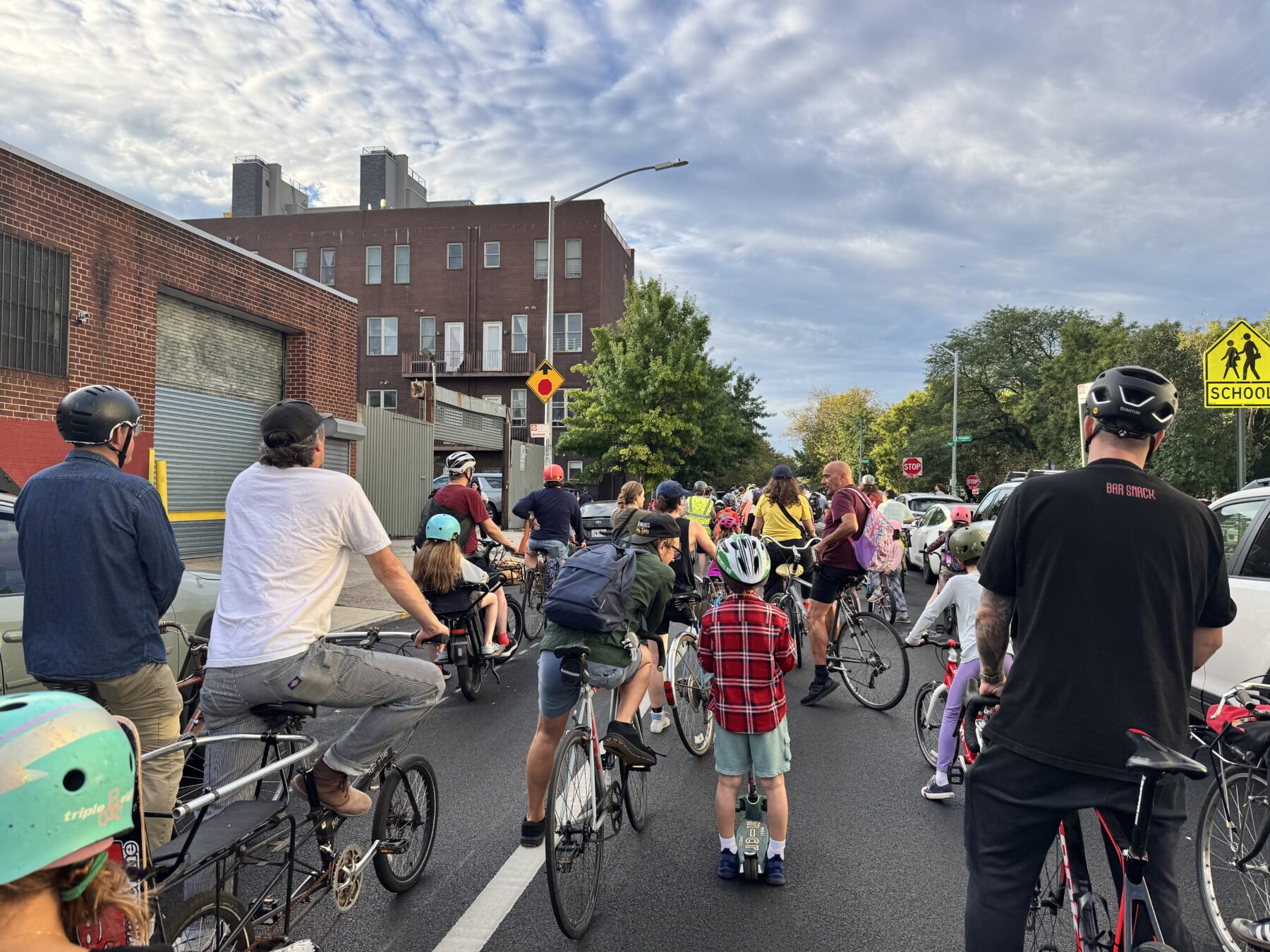
After the bike bus, during which students and parents ride to school together, P.S. 110 families gathered in the courtyard to chat before the school day began. (Credit: Manon Beliot)
In Greenpoint, Brooklyn, a proposal from the PS 110 Parent Teacher Association (PTA) to redesign Monitor Street has divided the block.
The group is asking the city to convert the one-way stretch between Driggs and Nassau Avenues into a two-way cul-de-sac with a pedestrian plaza in front of the school. Parents say the goal is to protect the 400 children who walk or bike there each day. Longtime residents, however, warn that the change could worsen parking shortages, block emergency vehicles, and complicate life for elderly neighbors who rely on deliveries.
Located at the corner of Monitor Street and Driggs Avenue, PS 110 sits on a busy cut-through used by trucks heading toward the Brooklyn-Queens Expressway. Although Monitor is not a designated truck route, enforcement is weak.
Over the years, the narrow corridor has become a pressure point in Greenpoint’s changing landscape. Industrial facilities along Kingsland Avenue still draw heavy trucks, while new residential buildings have brought more families walking and biking through the same space.
“Cut-through traffic has been a decades-long issue,” said Chris Roberti, vice-president of the PS 110 PTA. “In 1983, parents and neighbors formed a human chain to block trucks.” Four decades later, the problem persists.
The debate has drawn attention well beyond the block. State Assemblymember – and frontrunning mayoral candidate – Zohran Mamdani visited PS 110 in September to highlight the need for safer streets across Brooklyn, arguing that city roads should prioritize pedestrians over trucks and speeding vehicles. While he did not take a position on the specific proposal for Monitor Street, his visit underscored broader concerns about traffic safety in school zones. City Council member Lincoln Restler, who represents the district and is running for re-election unopposed, also supports rethinking Monitor Street and said that he favors “a design that expands pedestrian safety while preserving access for emergency vehicles and essential trips.”
The plan, currently under review by the Department of Transportation (DOT), has already been discussed at several Brooklyn Community Board 1 meetings. A preliminary redesign proposal was submitted to the DOT in July. Under agency procedures, the DOT must conduct a review to ensure emergency vehicle access and consult with elected officials before implementing any pilot program, but final approval lies with the DOT.
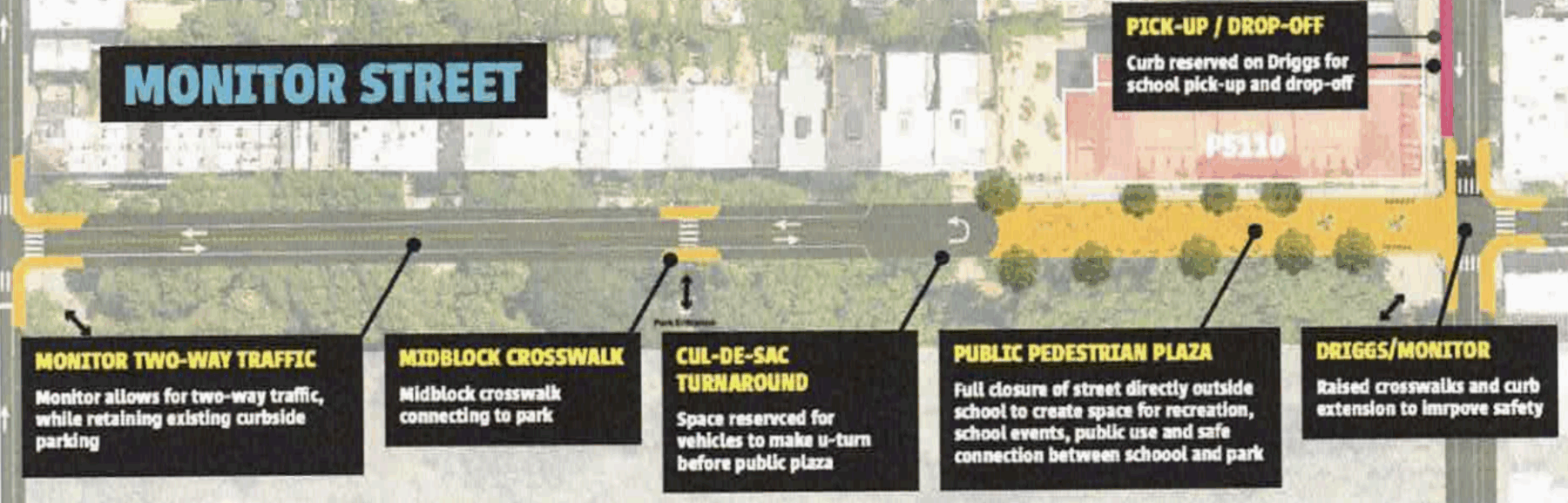
PS110 “Safe Street” Proposal
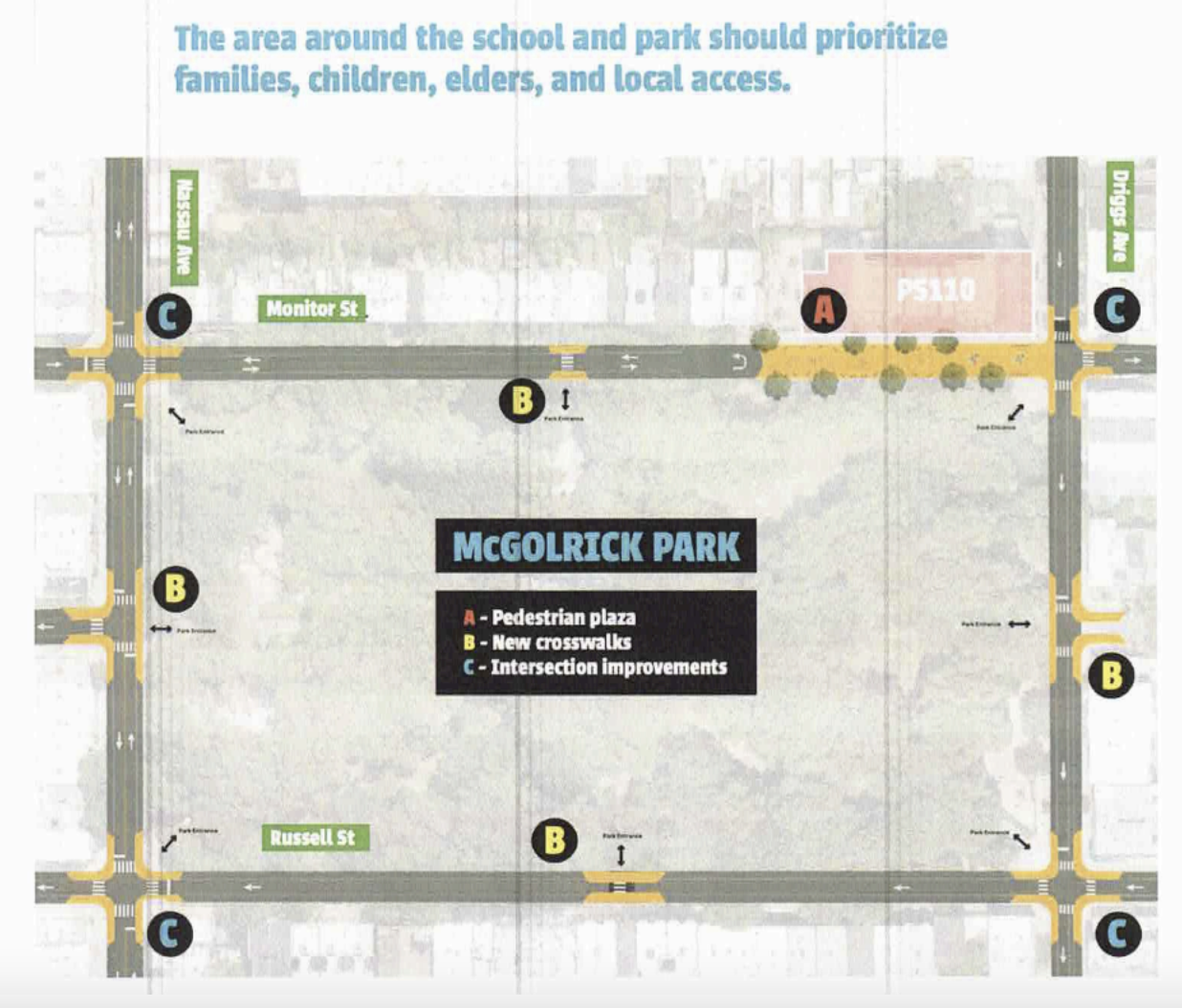
PS110 “Safe Street” Proposal
Parents argue that the redesign would discourage trucks from using Monitor Street as a shortcut and link PS 110 more safely to McGolrick Park across the street. Roberti said recent traffic deaths underscore the urgency: a PS 110 teacher, Matthew Jensen, was killed on McGuinness Boulevard in 2021, and in 2023, cyclist Teddy Orzechowski died at Monitor and Driggs.
For many in the school community, those incidents reinforced a sense that Greenpoint’s streets are built around vehicles rather than people. Parents involved in the PS 110 PTA have cited McGuinness Boulevard’s history of crashes and the daily flow of trucks using neighborhood side streets as evidence that enforcement alone is not enough. Their proposal, they say, aims to redesign the block so drivers naturally slow down near the school and fewer large vehicles cut through residential areas.
“It’s not like God created the street,” Roberti said. “It was designed by people, and people can redesign it to make it better and more suited for the residents of the neighborhood.”
Opponents counter that the redesign could create new safety problems. Nicole Hawro, a resident of the block, recalled a 2003 fire that displaced 29 families.
This fire remains a reference point for many longtime residents, a reminder of how dependent the neighborhood is on rapid emergency response. Greenpoint’s tightly packed buildings make fire access a recurring fear whenever new street designs are proposed.
“If fire trucks can’t come through, it could lead to another safety hazard,” Hawro said, referring to potential delays for emergency vehicles.
Beyond emergency access, residents say the proposed change could affect the rhythm of daily life on the block. They worry that basic routines, such as deliveries, waste pickup, and package drop-offs, would face new obstacles if trucks or vans could no longer drive directly to their doors.
Caitlin Taylor, who lives on Monitor Street, worries about deliveries for her elderly landlord.
For her, the debate is also about equity. Taylor and other residents say the focus on school safety often overlooks older neighbors who depend on access for, among other reasons, medical services.
“My landlord is 85, his wife passed away in 2020, and he depends on Meals-on-Wheels,” Taylor said.
She warned that a cul-de-sac would prevent delivery trucks from accessing the street, forcing drivers to carry merchandise from blocks away.
Parking remains one of the most divisive points. Residents argue the redesign fails to address the scarcity of spaces on the block. Lyn Pinezich, who helped organize opposition among Monitor Street neighbors by creating a talking group, said residents felt excluded from the process.
That sense of exclusion has fueled mistrust between residents and the PTA. Several neighbors said they first learned of the project through neighbors’ complaints rather than direct outreach from the DOT or local officials –– and felt that their input came only after major design choices were already made.
“No one from the block itself has been involved,” said Pinezich. “It’s a small group of parents who will move on to other schools, while the impacted people will live with this every day for the rest of their lives.”
Pinezich also questioned the plan’s feasibility, arguing it would create a dead end rather than a functional cul-de-sac.
During community board meetings, several residents shared her concern. They stated that Monitor Street is already tight for large vehicles and that converting it to a cul-de-sac could force emergency responders to back out or make multiple turns before reaching homes. They argue that, rather than changing the street’s layout, the city should focus on enforcing existing truck restrictions and ticketing vehicles that speed during school hours.
“Every vehicle driving down Monitor will either have to back up the entire very long block, make multiple K-turns, or drive through the plaza,” Pinezich said. “All of which makes this proposal far less safe for pedestrians than the current configuration, especially for children.” She noted that opposition is strong, with more than 400 signatures collected against the redesign.
Indeed, the current situation on the block is narrow, with cars parked tightly on both sides, leaving little room for a vehicle and a cyclist to move side by side. Even a delivery van often has to slow down or wait for an opening to pass. Speed bumps have already been installed on the block to slow down traffic, but residents and parents disagree over whether they go far enough to keep drivers in check. Although the PTA’s plan preserves most parking spaces and Roberti has described the proposal as a “Paris-style school street,” the comparison is imperfect: streets in Paris typically accommodate smaller cars and lighter traffic than those in New York.
The PTA maintains that safety, not convenience, should guide the project.
Indeed, parents argue that small adjustments will not solve deeper design flaws that make Monitor Street feel unsafe. They see their proposal as a rare opportunity to change how the block functions rather than relying on temporary fixes that fade once enforcement wanes.
“My priority, number one, is the safety of kids and families,” said Roberti. “My priority, number two, is access to emergency services and access for the neighbors so that they can get in and out of their homes, especially the elderly people who need it. Their parking is… maybe a distant third.”
For Roberti, the redesign could also serve as a model for other schools in North Brooklyn that face similar conflicts between through-traffic and pedestrian safety. He hopes Monitor Street can become an example of how infrastructure changes might prevent future tragedies rather than respond to them.
He pointed to the street’s design as a core issue.
For both sides, the question is whether design can truly change behavior. Parents see barriers as the only way to make drivers slow down, while residents doubt that disrupting their daily lives will make the street any safer.
“Monitor is wide and straight enough to accommodate these gigantic trucks, and that also invites fast-moving cars. Our big request is safety through design, to make streets basically impossible to speed on and impossible to kill anyone on,” said Roberti.
For now, the DOT has not announced a timeline for a decision. Whether Monitor Street ultimately becomes a cul-de-sac or remains a truck corridor, residents on both sides say they want the same thing: a street that is safe for the children who cross it every morning and livable for the neighbors who call it home.
About the author(s)

Manon Beliot is a Columbia Journalism School student and Editor-in-Chief of La Revue [DEMOS], where she oversees coverage of global and political affairs.