




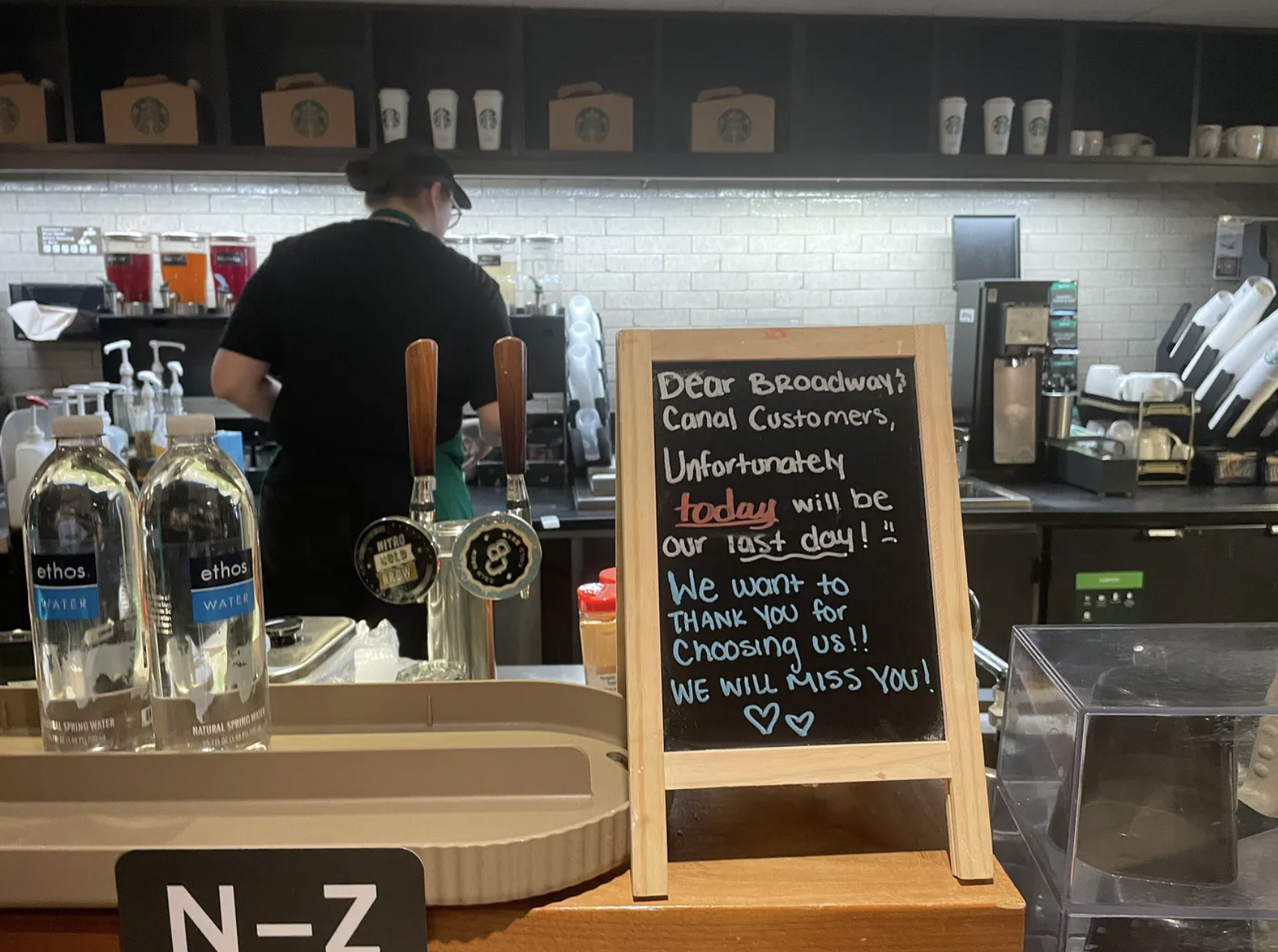
Starbucks on Broadway and Canal bids farewell to its customers. (Credit: Genny Gottdiener)
At least 30 Starbucks stores closed over the last weekend in September in New York City, part of a company-wide effort to shutter hundreds of locations nationwide. Employees say they were only given 48 hours to prepare.
“We found out about this whole thing happening basically from the news,” said Dima Tkachenko, 22, who said he started working at the Starbucks on Broadway and Canal shortly after arriving from Ukraine two years ago.
CEO Brian Nichol stated Thursday that the company is closing “coffeehouses where we’re unable to create the physical environment our customers and partners expect, or where we don’t see a path to financial performance.” The company didn’t specify which stores would close, but employees have taken to Reddit to compile their own spreadsheet. They predicted which stores would close by checking Starbucks’ store locator; if a location’s hours showed “closed” starting on Sunday, Sept. 28, that indicated a shutdown. The list also tracks each location’s union status.
Tkachenko works at a union store. Three blocks away, another union location is facing the same reality.
“I think the union helps protect us … but at the same time, it’s corporate America,” said Man Wong, an employee at the 444 Broadway location in downtown Manhattan, as he clocked out of his last shift.
Nineteen locations in New York City are unionized under the Starbucks Workers United (SBWU), and five of them are closing. Before these closings, there were more than 300 stores in New York City, with about two-thirds of those in Manhattan.
Some employees wondered if their union status made them more likely to lose their jobs, but officials said this is not the case. “Represented [unionized] status is not a factor when we consider whether to close a store,” wrote spokesperson Sam Jefferies, in an email to Columbia News Service.
Wong’s store unionized a year ago, around the same time that Nichol rolled out his Back to Starbucks strategy. The plans have included such changes as simplified menus, a stricter dress code, and reductions in the workforce. Nichol hopes to bolster the company’s stock, which has fallen by 19% over the past six months. The company also faces headwinds from President Donald Trump’s 50% tariffs on Brazilian goods, which have been particularly taxing on the coffee industry.
Employees say the Back to Starbucks initiatives have been misguided.
“They started requiring you to write on cups and if you don’t, you can get disciplinary action,” Wong said, shaking his head.
Tkachenko was frustrated by the recent dress-code changes. “Starbucks used to be known for the fact that at least we could show our personality,” he said. Three states took legal action against Starbucks this month, alleging that employees were not reimbursed for uniforms. The company says it provided two free company-branded t-shirts to every worker.
Tkachenko said he was so frustrated that he had already been contemplating leaving.
“I was ready to move on for a while now … I feel like it’s divine intervention,” Tkachenko said.
He isn’t the only one who saw the layoffs as an opportunity.
Lilli Drost is a barista at the West 81st Street and Broadway location, which was once featured in the iconic New York movie “You’ve Got Mail.”
“I just don’t like how we run it,” Drost said. “This is the kind of job where you just put your head down and work and don’t ask questions.”
Drost isn’t confident that she’ll be transferred to another location. “They said you would enter a job pool and get first dibs. But I think it’s based on seniority, so since I’ve only been here a year and half, I’m just going to go somewhere else,” Drost said.
Other employees were devastated by the news.
“I’m very emotional right now,” said Jazzy, a barista on the Upper East Side who asked to only use her first name, as she hopes to work at another Starbucks. “It feels like they’re tearing my family apart.” She has been writing “I will miss you” in careful lettering on the cups she hands to customers.

Starbucks employees write farewell messages on cups on the Upper East Side. (Credit: Genny Gottdiener)
For loyal customer Bruce Kirschner, the Starbucks on East 80th Street and Second Avenue has long been a part of his daily routine. “This is my hour of sanity,” he said, cradling his coffee.
“Selfishly, I’m sad because I have to walk over to 3rd Avenue now,” Kirschner joked. “But also the practice of just suddenly closing a place… I think it’s incredibly unfair to just spring it on people on a Friday.”
About the author(s)

Genny Gottdiener is a Stabile Investigative Fellow at Columbia University's Graduate School of Journalism.