




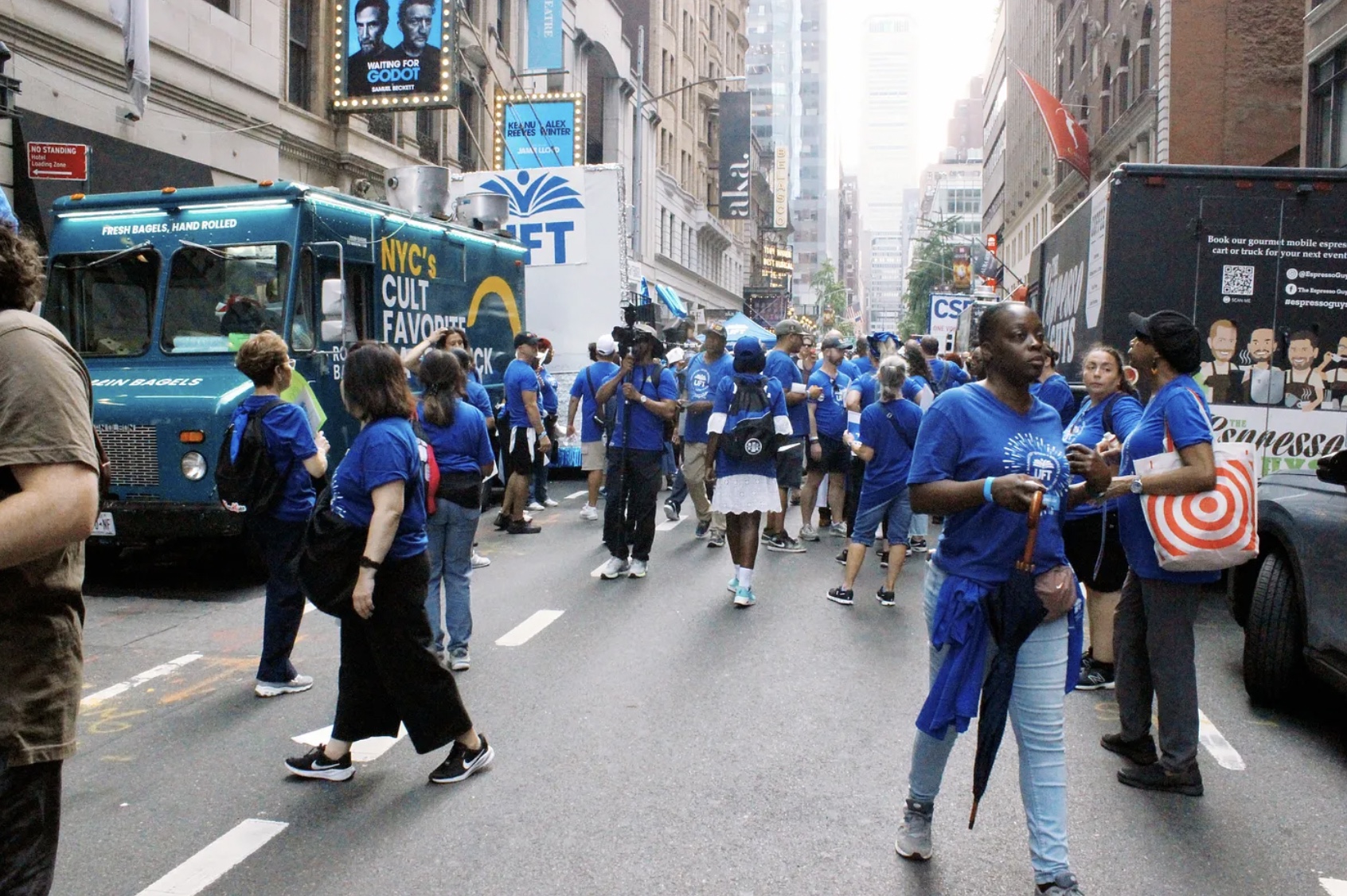
Members of United Federation of Teachers at the Labor Day Parade on Sept 6. (Credit: Julie Lee)
Niketa Hyder had a headache.
In early September, Hyder, a special-education teacher in Harlem, started to feel unwell. The next day, her symptoms weren’t going away, so she took a COVID-19 test.
“Lo and behold, it was actually COVID,” she said.
It was Hyder’s third time contracting the virus, but this time, things were different — not just for her, but for the tens of thousands of public-school teachers in New York City.
COVID cases rose this August, just before students and teachers returned to the classroom. An increase in coronavirus between July and September is common. Until recently, teachers were able to take up to 10 days of paid sick leave if they got the virus, in addition to their usual bank of absence days, which has more restrictions.
But as of this school year, teachers who contract COVID-19 have to dip into their absence reserve — or show up to work anyway.
Martina Meijer, an elementary-school teacher in Brooklyn, said she has friends who faced this dilemma.
“I know three people who missed the first day of school,” she said. “One of whom is a close friend, who felt pressured by their administrator to come in as soon as they don’t have a fever.”’
The end of COVID-19 days was attributed to the expiration of a state law passed in March 2020. That law guaranteed sick leave for workers who needed to quarantine due to the virus. Gov. Kathy Hochul first proposed to sunset the law in the 2024 budget, but in the final budget, the end date was pushed another year to July 31, 2025. When that year was over, COVID-19 days were gone for good.
“To yank it away from people, forcing us to use our sick days, I don’t think it’s right,” said Taiba Ahmad, an elementary-school teacher in Queens. “Especially if you’re putting us in petri dishes all day.”
Hyder, the special-education teacher, had enough days in her absence reserve to take off and recover from her COVID-19 infection, but others do not.
Both Ahmad and Meijer pointed out that the loss of COVID-19 days could disproportionately affect women.
“I have teacher friends who just returned back from maternity leave,” said Meijer. Those friends “completely depleted” their absence days, she added, meaning that any COVID-19-related absences would be unpaid.
People with the virus can be infectious for 10 days, or longer if the illness is severe, according to the city Department of Health and Mental Hygiene. With COVID-19 days gone, teachers may have less incentive to stay home for the full duration of the illness, even if the risks haven’t gone away.
Repeat infections can increase the risk of developing long COVID, in adults and children. In a new study of almost half a million children and adolescents published in September in Lancet Infectious Diseases, researchers reported that a second infection doubled the risk of developing long COVID.
Ahmad, who also has asthma, said she contracted COVID-19 twice last year.
“The second time I got it, it took me well over a month to get my breathing back,” she said.
COVID-19 rates peaked in mid-September and are now on the decline, but the lull may not last. Thanksgiving is approaching, and the long weekend tends to coincide with an increase in COVID cases.
“You expect there to be peaks during the holidays,” said Dr. Kaswar Talaat, a physician and associate professor of epidemiology at Johns Hopkins University. “People gather, and then they travel, they gather, they get exposed, then they go home and expose their classmates and friends.”
About the author(s)

Julie Lee is a Stabile investigative fellow and previously covered issues such as surveillance technologies, artificial intelligence and the criminal legal system.