




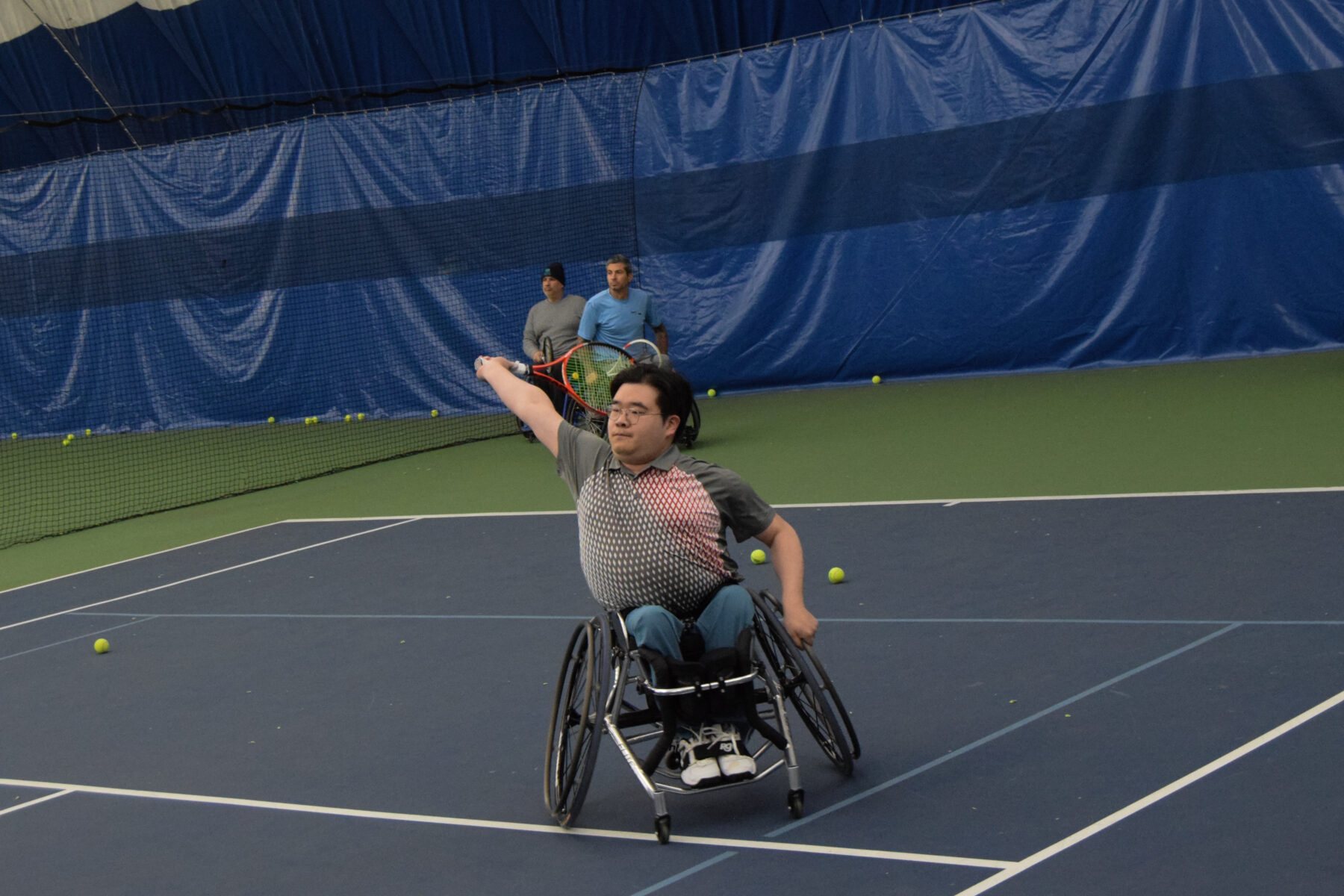
Wonik Son lines up to return a hit during practice at Commonpoint Tennis Center, Queens, NY on December 7th 2025.
On Sunday afternoons at the Commonpoint Tennis Center in Queens, Joe Slaninka wheels himself to the baseline and locks eyes on the ball arcing over the net. With a sharp pivot of his chair and a clean swing, he sends it back cross-court. After more than 30 years of wheelchair tennis, the movement is now second nature.
Slaninka was born with spina bifida, a congenital condition that can often cause paralysis in the lower limbs. He was introduced to wheelchair sports at 18 while attending Stony Brook University. What began as a way to stay active quickly became something much more meaningful.
“Wheelchair athletics opened up so many doors for me,” Slaninka said. “I’ve had a lot of great opportunities, met a lot of great people and have been to a lot of great places.”
Now a physical education teacher on Long Island at a school for students with severe disabilities, Slaninka spends his weekdays encouraging young people to participate in sports as a way to build confidence and community. On weekends, he returns to the court as one of the most experienced athletes at the Wheelchair Sports Federation’s weekly tennis practice, a free program for adaptive athletes across New York City. The program is largely funded by individual contributions, fundraising events, and grants from foundations.
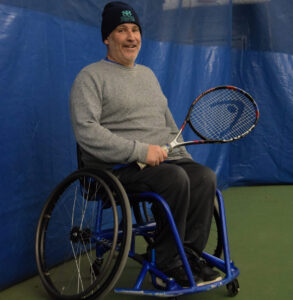
Joe Slaninka poses for a portrait during tennis practice at Commonpoint Tennis Center, Queens, NY on December 7th 2025.
Stories like Slaninka’s are becoming increasingly common, with the nationwide disability rate in ages 25-55 climbing from 9.0% to 9.6% from 2019 to 2022. Nearly 11% of New Yorkers, around 900,000 people, live with a disability, according to city data. Roughly 1 in 15 has an ambulatory disability, meaning that they are partially or fully unable to walk. Many of these residents face barriers to accessing recreation, including cost: Specialized sports wheelchairs, which are typically excluded from insurance coverage, often start around $5,000 for a low-end chair, placing them beyond the reach of any living on fixed incomes or disability insurance.
A report by State Comptroller DiNapoli in 2024 revealed that roughly 25% of people with disabilities in the city were living below the poverty line, compared to 1 in 5 nationally. With so many adaptive athletes unable to access the necessary equipment, the Wheelchair Sports Federation closes the gap by providing 50-75 sports wheelchairs per year to youth and adult athletes who need them around the U.S. and the world. Without these specialized chairs, playing would be unfeasible and even dangerous.
At the practice sessions in Queens, athletes swap their everyday wheelchairs for nimble sports wheelchairs, with thin cambered wheels that prevent tipping and aid acceleration and speed. They line up on the baseline and one-by-one wheel forward to return balls fed from a volunteer on the other side of the net.
“All those chairs at the tennis center were formerly used by somebody,” said John Hamre, president and co-founder of the Wheelchair Sports Federation. “People donate them or we purchase them and fit them as a temporary solution, it helps get people initially interested in sports, and then we find them their own chair.”
For newcomers, the learning curve can be steep, not only mastering tennis technique, but navigating life with a disability. Ariel Abal, originally from Argentina, was diagnosed with multiple sclerosis at age 24 and medically discharged from the U.S. Navy. Now 53, he credits tennis with helping him regain a sense of purpose after struggling with mental health challenges.
“I was so active my whole life,” Abal said. “I found myself in this predicament where I had to use a wheelchair. I just couldn’t think about living that way.”
Abal currently practices in a chair provided by the Wheelchair Sports Federation while he waits for a custom sports wheelchair to be delivered, a process that for most people can take months and requires fundraising or grant support. For many first time adaptive athletes, the loaned chair is the difference between trying a sport and dropping out before they’ve even begun.
The Wheelchair Sports Federation offers youth and adult adaptive sports opportunities across New York City, with basketball, tennis and sled hockey practices running throughout the winter, and seasonal sports rotating the rest of the year. The organization also partners with Wheeling Forward, a nonprofit adaptive sports organization, to offer water-sports like water skiing and surfing.
Hamre believes that programs like the Wheelchair Sports Federation’s are critical to expanding opportunities and changing public perceptions about what people with disabilities can achieve.
For athletes who have yet to discover these opportunities, he hopes that the Wheelchair Sports Federation can be a place where the possibilities become visible and participation begins.
Slaninka believes that visibility is key to increasing fundraising numbers and getting more people involved in the organization. The more people who are aware of adaptive sports opportunities, the more young people can imagine what is possible for themselves.
“People with disabilities live active, complete lives. We’re out there playing sports, going to work, raising families. We’re not just sitting at home watching TV,” Slaninka said.
About the author(s)

Amarna Milne is an M.S. student at Columbia Journalism School, specializing in sports journalism.