




Animal rights protesters demonstrate outside City Hall on Sept. 10. (Credit: Aleah Gatto)
One afternoon in September, a young couple pushing a child in a stroller asked Ahmet Bilici to take them on a ride around Central Park in his horse carriage. For the next half hour, the family rode around the park’s southern drives while Bilici guided his horse, Chocolate. After the family paid for their ride and went on their way, Bilici parked at the end of a line of other carriages, then brushed and fed Chocolate while waiting for his next customers.
“My family is two horses, two sons, and me and my wife. So six people,” he said, laughing. He has driven carriages since immigrating from Turkey in 2003, after earning a veterinary degree in Istanbul, he said. His earnings support horse care, rent, food, and his children’s education.
Bilici is one of 170 unionized carriage horse workers who could lose their jobs if the City Council passes Ryder’s Law — a bill to ban horse-drawn carriages by June 2026.
On Sept. 17, Mayor Eric Adams signed an executive order endorsing the bill, which already has the support of 20 of the 51 council members. Named after a carriage horse that died in 2022, it requires “humane disposition of carriage horses” and a “workforce development program” to transition drivers into other industries.
“The way I earn an income to pay for my horse and the way I earn an income to pay for myself would be gone,” said Jill Adamski, another carriage driver. “So I have been in a bit of a panic.”
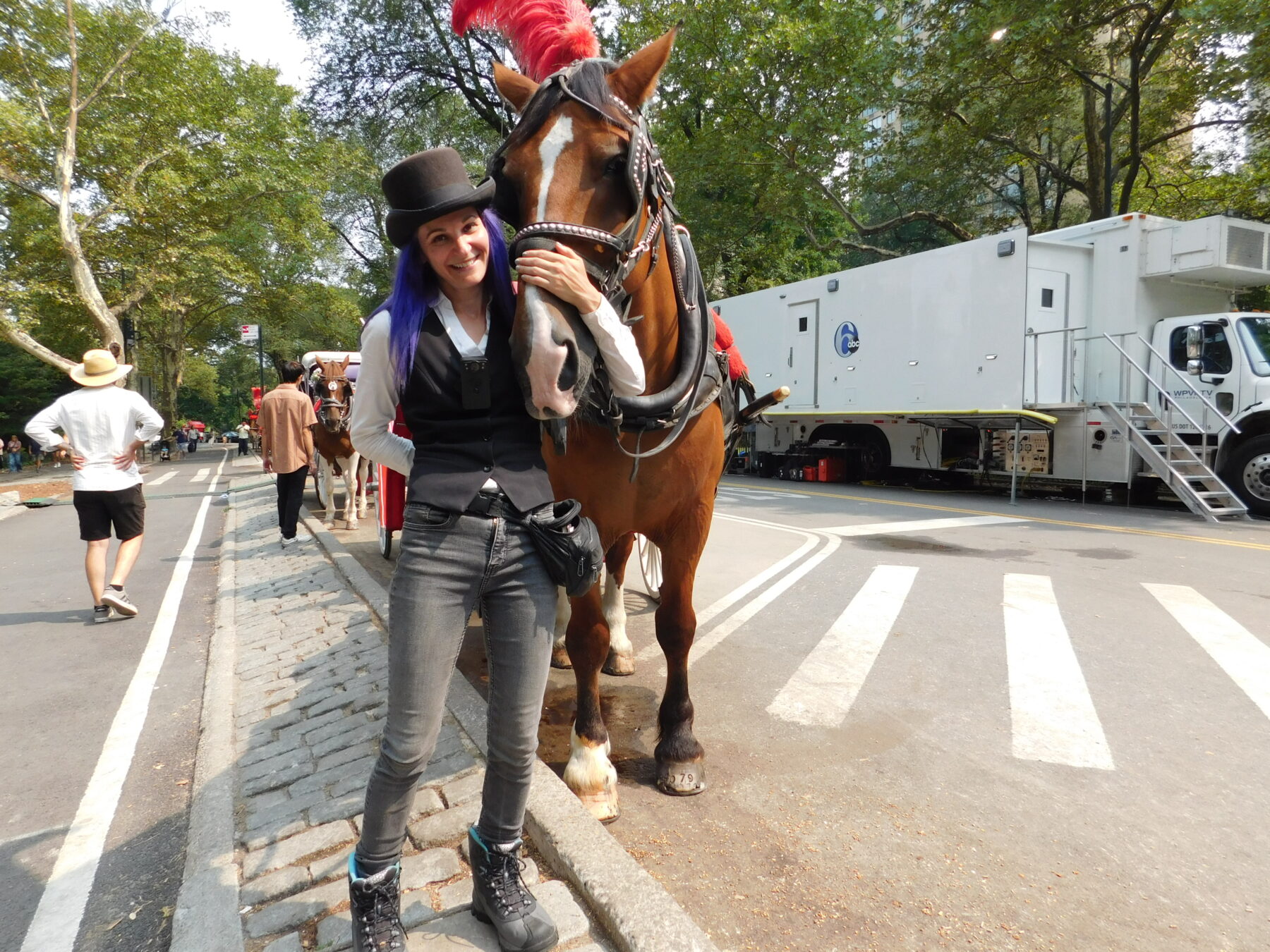
Carriage driver Jill Adamski and Nick, a Clydesdale mix, at Grand Army Plaza. (Credit: Aleah Gatto)
Manhattan Councilman Erik Bottcher, one of the bill’s main sponsors, said the city would work with “equine experts who are very familiar with how to humanely relocate horses.” As for workers, he argued, “I think a win-win is possible here.… They could actually make more money and have even better jobs.”
But no carriage worker who spoke with Columbia News Service believed the bill serves the best interest of horses or themselves.
Christina Hansen, a carriage driver and representative for the Central Park Horse Carriage Division at Transport Workers Union (TWU) Local 100, called Bottcher hypocritical for backing a bill that would hurt workers in his own district.
“We are his constituents,” she said. “Not only do all of our horses live in his district, but there are five or six carriage drivers who live in this district.” Bottcher’s district includes Hell’s Kitchen, home to the Clinton Park Stables, the largest of three in Manhattan.
In early August, Bottcher joined NYCLASS, Republican candidate for mayor Curtis Sliwa, and other animal-rights advocates in a rally outside the stables after a young mare named Lady collapsed and died.
“He actually came here, did a bunch of media stuff across the street with the animal-rights people, talked about how terrible it was and why we’ve gotta be banned,” Hansen recalled. He “could not walk down here to offer his condolences to the people that actually knew, loved, and cared for this horse. But he wanted to be on TV.” An autopsy determined that Lady had a tumor that led to a sudden aortic rupture, according to TWU.
Despite the city Department of Health’s stringent requirements, NYCLASS Executive Director Edita Birnkrant has repeatedly identified the industry’s shortcomings. In an interview, she said that the treatment carriage horses receive is deplorable when compared to the care for horses from the city police department.
On Labor Day, bystanders captured video of a carriage horse in training, bolting after being frightened by a garbage truck. “Horses can spook at any moment,” said Birnkrant. “It doesn’t matter how well-trained they are.”
Bilici described his routine with Chocolate, his retired racehorse, and Black Star, his crossbred draft horse: arriving at the stables early to bathe, brush, and feed them before bringing them to the park. Stablehands work around the clock, but Bilici comes in for emergencies himself.
“Our horses are so much luckier than many other horses,” he said, citing city-mandated check-ups, vaccinations, grooming, five weeks minimum vacation, restrictions for working in poor weather, and other provisions. “This is not animal cruelty,” he said. “This is animal care.”

Carriage driver Ahmet Bilici posing with his horse, Chocolate. (Credit: Aleah Gatto)
“The animals-rights people have their opinions,” said TWU Local 100 President John V. Chiarello. “The carriage operators — they’re our members. We’re not gonna lay down, no matter what.”
According to TWU International President John Samuelsen, the union has been lobbying City Council members directly. Still, a sudden endorsement of the bill from the Central Park Conservancy and a Sept. 10 rally outside City Hall with NYCLASS, PETA, and several members of City Council, have kept carriage workers on edge.
Adamski hopes Ryder’s Law doesn’t get to the floor for a vote. “But in that situation,” she said, “I want them to really consider us as people.”
About the author(s)

Aleah Gatto is an M.S. Candidate specializing in investigative reporting at the Columbia Journalism School.