




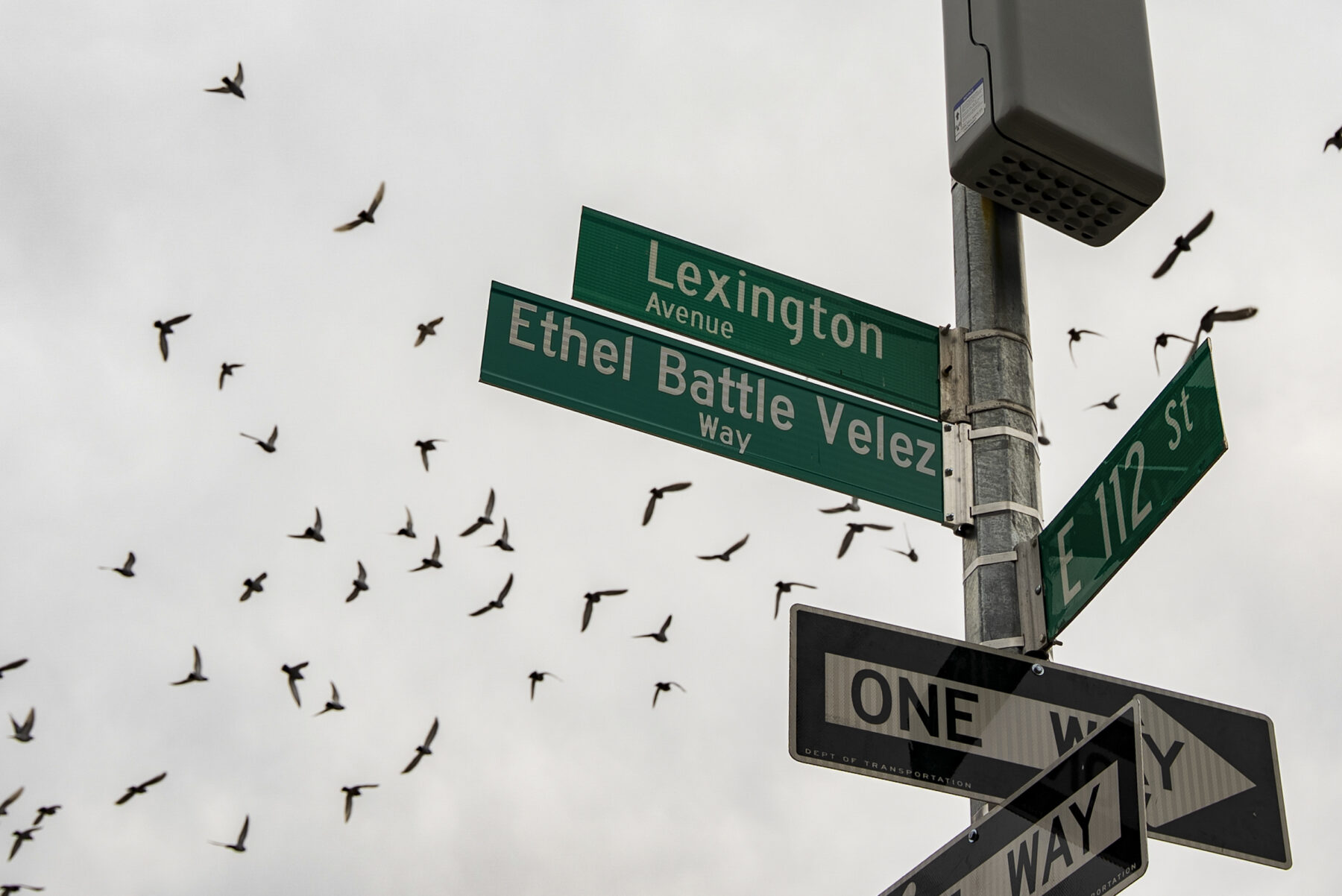
Ethel Battle Velez Way street sign. (Credit: Max Rykov)
On a gloomy Saturday in East Harlem, a new street sign appeared at 112th St. and Lexington Ave.: Ethel Battle Velez Way. Beneath it, Janet Velez held her family close and reflected with the attendees at the renaming ceremony – neighbors from Johnson Houses, city officials, and friends who were each uniquely influenced by her mother. They all knew her as the woman that never stopped fighting for her community. City Council member Diana Ayala, who helped spearhead the effort, stood beside the Velez family.
Ethel Battle Velez lived in the New York City Housing Authority Johnson Houses from the time she was six months old. She led its tenant association for nearly 40 years until the day that she died at 77 last January. Her eldest daughter, Janet, the only one of her children still living in the Johnson Houses, said the renaming ceremony brought both immense pride and the promise that upholding her mother’s legacy won’t end with a sign.
For those who lived and worked beside her in the community, Ethel Battle Velez’s impact was physical, social, and intergenerational. She pushed tirelessly to make tenant voices heard and believed public housing communities should be able to run themselves.
For 20 years, she fought to move the Johnson Houses’ cramped basement social center above ground. The result was a modern facility with a gymnasium, a dance hall, and an outdoor amphitheater. She secured Section 3 hiring so that residents could learn the trades and become electricians, maintenance workers, or elevator technicians while transforming much needed repairs into career opportunities.
Her longtime friend and colleague, William Abbott, recalled when city budgets cut youth programming in 2009, so Ethel forged a coalition among the presidents of the neighboring NYCHA houses to fund their own summer programs internally.
“Thanks to her, there’s not a single doorway that doesn’t have a light above it,” Abbott said, listing the many improvements to quality of life that were all traced back to Ethel.
He pointed to the life-size statue of James Weldon Johnson that Ethel once had to personally track down and return to its place after it was stolen from the complex.
“She was the leader of leaders,” Abbott said. “People are still crying today, me being one of them.”
In the months since she died, residents have begun to worry that without Ethel’s guidance and energy, her hard-won progress could unravel. Her next door neighbor, best friend, and Tenants Association Member Charlotta Davis said one of Ethel’s final wishes was to keep the Johnson Houses from falling into private hands.
“They’re coming after us this year,” Davis said, referring to private investors. “They already came after us.”
Faced with a $78 billion backlog in needed repairs and heavy reliance on federal grants, NYCHA has increasingly turned to public-private partnership models to help bridge the gap. The city’s Permanent Affordability Commitment Together (PACT) initiative converts developments to project-based Section 8 financing and brings in private or non-profit management. In October 2025, NYCHA announced that 39,000 units across 146 developments are already in the pipeline toward private management, with a goal of 62,000 privatized units by 2028. While these transitions might bring repairs, tenant advocates warn that they diminish resident power. A 2024 audit by the NYC Comptroller’s Office found that eviction rates at PACT developments were over five times higher than those in traditional NYCHA housing, largely because many PACT managers bypassed the required pre-eviction outreach, repayment plans, or tenant-protection procedures.

Janet Velez and her daughter, Amanda, after the street renaming ceremony in East Harlem. (Credit: Max Rykov)
As the ceremony at the street corner came to a close, the crowd drifted across the street and into the courtyard of the Johnson Houses. Classics of Diana Ross and Bill Withers played on large speakers and neighbors set up a folding table with chicken, green beans, and mac and cheese to pass out on paper plates. Every few feet, under a banner that commemorated Ethel, a different circle of people reminisced. “Everyone has a different story when it comes to my mother,” Janet said she has discovered. She consistently hears stories for the first time about how her mother helped someone get their first job, or finish school, or join a union.
Among the people sharing memories was Ethel’s aunt, Patricia Velez.
“She was able to raise three children, but her first priority was the community,” Patricia said. “She has left a legacy. And her daughter, Janet, is running with it.”
While her mother took a more publicly political path in advocating for public housing tenants, Janet’s career has focused on special education and equity. She spent 35 years as a paraprofessional and union representative in the United Federation of Teachers (UFT).
Recently retired, she has been reaping the benefits of the same intergenerational “Elders and Youth” program that her mother started in the Johnson Houses’ basement community center. As a child, Janet was in the program on the youth side. She grew up taking part in “youth patrols,” helping seniors with errands, and joining Fresh Air Fund weekend camping trips alongside elders from the neighborhood. Now, she’s part of the program as a senior herself.

Janet Velez outside of the Ethel Battle Velez Community Center. (Credit: Max Rykov)
“I was looking to retire quietly,” Janet admitted. “Now it’s more about the project of telling my mother’s story, and exactly what that looks like, I’m still not sure.”
In many ways, Janet’s and Ethel’s work is more similar than different. Both of them operated in a system that’s often overburdened and underfunded, one supplying essential needs for the collective right to thrive, and one for the individual’s right to grow. Both avenues required an uncommon degree of emotional perseverance.
“Now, to be considered as the head of the family is a little scary and intimidating,” Janet said, “but my goal as an educator is to share what social action looks like.” She’s come to envision a longer journey of sharing her mother’s work on what it means to be an activist, an organizer, and a leader in the community.
Back in the section of the courtyard that Ethel always called “the living room,” Janet gathered everyone around two cakes. It had been her mom’s birthday just a few days before. They sang Happy Birthday twice — first the traditional version, and then the gospel-style Stevie Wonder version. Laughter and chatter rang through the yard as Janet cut the first slice while her brother Buddy Velez and younger sister Jennifer Velez Harrison handed out plates. Around them stood many of the same people their mother had once organized, protected and celebrated.

Janet Velez commemorating her mother alongside younger sister, Jennifer Velez Harrison, and aunt, Patricia Battle. (Credit: Max Rykov)
As Sly & the Family Stone’s “Everyday People” played over the loudspeakers, the courtyard felt alive with everything that Ethel left behind: the laughter, the pride, and the sense of a community that could sustain itself. Across Lexington Avenue, the new green sign, Ethel Battle Velez Way, shone under the streetlights, visible from the gates.
“As much as [Ethel] was like my big sister, or aunt, or my teacher, it’s hard to imagine what I was going through if she was my mother,” Abbott said.
Earlier that day at the ceremony, Janet distributed letters on behalf of the Velez family, a message she called both a tribute to her mother and a plea to the community in her time of grief. It read, “As we celebrate this milestone, we ask that you continue her legacy.”
It is widely accepted among Velez’s family and colleagues that it would be impossible for a single person to fill her mother’s shoes. Their hope is that people can step forward and carry the weight of advocacy together.
“Continue to advocate for fairness, inclusion, and justice in your neighborhoods,” the letter read, “that is how her spirit will live on not just in our memories, but in our actions.”
About the author(s)

Max Rykov is a Ukrainian-born journalist and documentary filmmaker. He is pursuing his M.S. as a part-timer at Columbia Journalism School.