




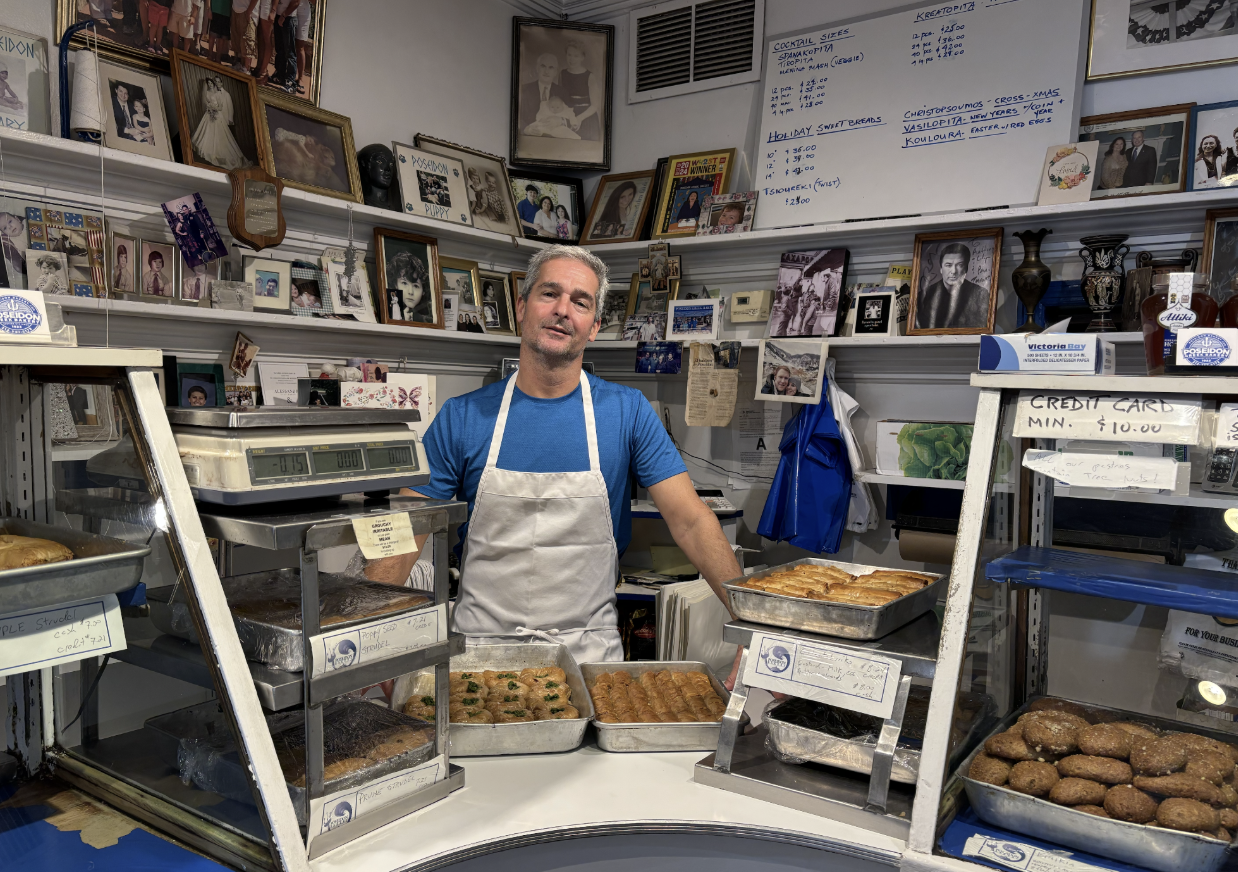
Paul Fable, a fourth generation baker, behind the counter at Poseidon Bakery. (Credit: Maya Himelfarb)
The secret to Poseidon Bakery’s 103 years can be found in the apartments above the shop, where the owner’s family has lived for five generations.
Demetrious Anagnoustou opened the bakery in 1923, shortly after immigrating from Greece. Today, Poseidon operates much as it did over a century ago, with recipes written by Demetrious still baked in the 150-year-old oven he sourced himself.
From Tuesday to Saturday, the bakery in Hell’s Kitchen opens at 10 a.m. and closes at 6 p.m. Around 11:30, the staff prepares its signature handmade phyllo dough, about 25 pounds a day, to wrap around sweet and savory pastries. Extra pastries are frozen during the year in preparation for the Greek holiday season, when customers flock to the bakery in search of traditional sweet breads and cakes.
Poseidon is one of the last bakeries in America to make phyllo entirely by hand instead of using industrial machines, carefully stretching the dough over long tables until it is paper-thin, then resting it under thick cloths and then carefully layering it to create its signature flaky appearance. Over the years, the bakers have become masters of their craft, tweaking the ratio of flour to water to account for New York’s changing seasons and humidity levels.
“You’re never going to see anything like this anywhere else,” said Avi D’Araujo, who has made phyllo at Poseidon for 15 years. “Nobody makes phyllo by hand anymore. It’s just, practically, not worth it.”
Over the past few years, D’Araujo and Poseidon’s other bakers have seen the cost of ingredients rise dramatically, rendering the beloved phyllo one of the bakery’s biggest expenses. Nearby restaurants who once purchased the dough in bulk are now dropping out in search of cheaper products, leaving only the most high-end restaurants on what was once a long list of clients.
At $17 for one pound of dough, Poseidon’s handmade product costs more than three times the average rate for machine-made phyllo. According to Paul Fable, the original owner’s great grandson, nearly 45-50% of Poseidon’s restaurant clients have stopped sourcing at the bakery because of the increase in prices. “Higher-end places can afford to pay because they can then put that onto the customer. They can charge like $15-16 for a dessert,” Fable said. “I used to have a lot of mid-range restaurants, but they want to charge their customers $6-7 for a piece of baklava. At $17 a pound, they’re gonna sit there and say, what am I making on this?” Fable sells his baklava for $8 a piece.
Without the revenue from restaurant clients, most of Poseidon’s income now comes from retail. In the years following the pandemic, Fable has raised the prices of pastries by 10-12%, a number he claims would be significantly higher if not for the fact that his great grandfather bought the building Poseidon operates out of during the bakery’s early years. To this day, the family lives in apartments above the shop, and employs just four staff members to keep the costs of labor low. Both Paul and his mother continue the family tradition of working full-time in the bakery.
The Fables believe that any changes, even those that might cut costs or bring in more revenue, would betray the very thing about Poseidon that keeps people coming back. When a customer comes in and asks for a recommendation, Fable points them to whatever is still warm from the oven, urging them to eat it immediately. If a recipe has a backstory, like the mixed-vegetable Menina Mash named for the grandmother who worried that the Fable children weren’t otherwise getting their daily vitamins, customers can expect to hear it before the pastry is passed over the counter.
“We’ve always kept everything the same,” Fable said. “Because when someone comes in five, ten years later, they’re gonna remember that exact same pastry, and how it tasted.”
Occasionally, a pastry will become too expensive or time-consuming to produce, and the Fables cut it from the menu. Kataifi, a greek pastry made from shredded dough, requires two people and an entire day of work just to produce nine trays. After Paul Fable’s father retired, the family couldn’t justify the effort without hiring more staff members, which would have been too expensive. Nothing new has been added to the pastry case since 1940, when the original owner’s son married an Austrian woman who learned to make strudel out of the phyllo dough.
Poseidon’s survival is a direct product of its history. The modest storefront, with its blue and white overhang, remains a monument to the bakery’s past. The shop itself is as much a shrine as the dozens of family photos and celebrity headshots that line the shelves behind the counter. “My great grandfather put us in this situation,” said Fable. “If it wasn’t for that, there is no way I would be able to do this for you. I would have to charge much more.”
About the author(s)

Maya Himelfarb is a journalist and M.S. candidate at the Columbia University Graduate School of Journalism.